The Shenzhen Delusion: Why Planned Cities Keep Failing to Recreate China's Instant Megacity

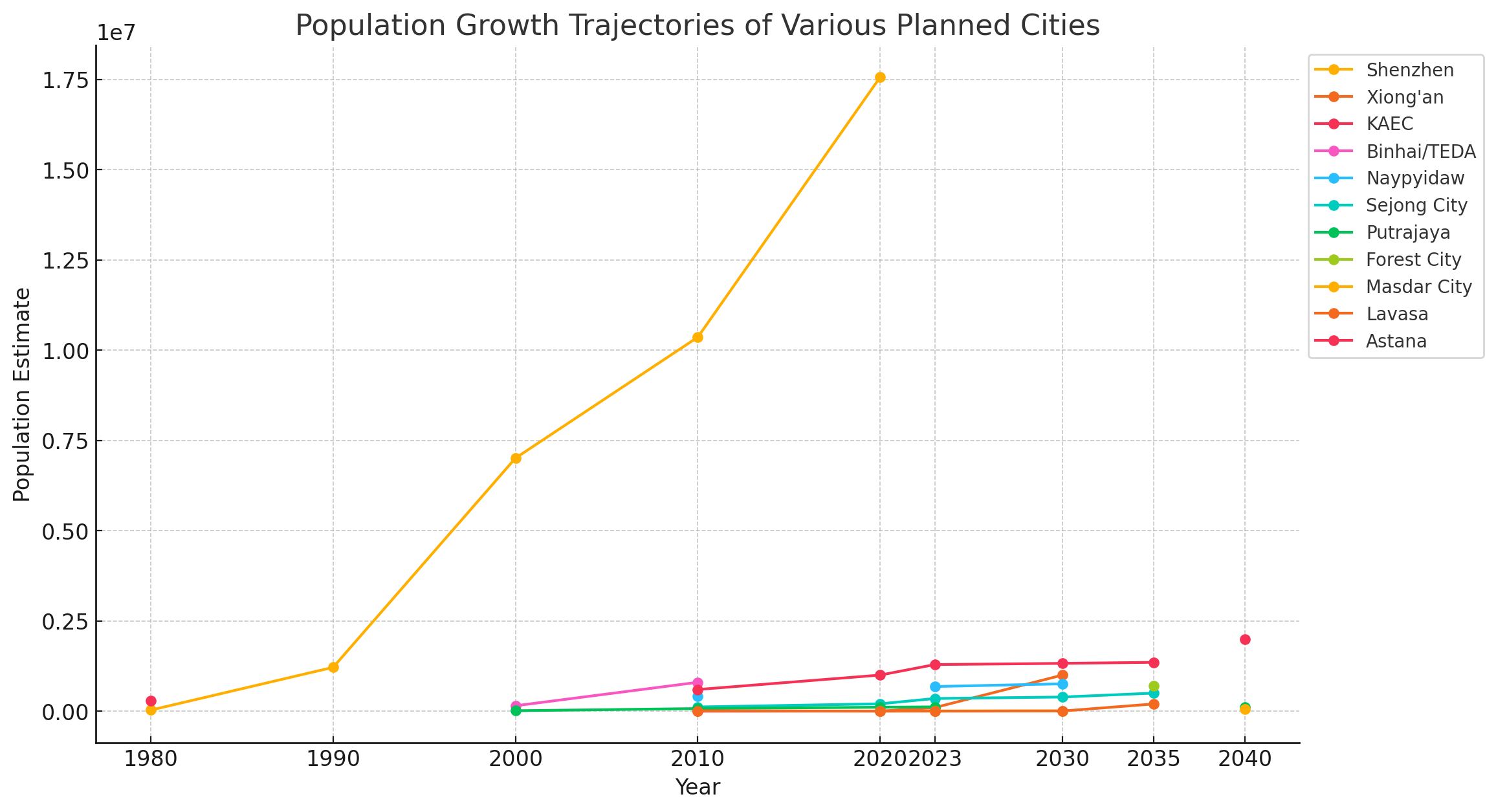
In 1979, Shenzhen was a fishing village. Today, it is a 17-million-strong megalopolis, a global tech hub, and one of the most mind-bending urban success stories in history. In Shenzhen, factories-turned dorm-room startups blossom into trillion-dollar tech giants, and a hyper-efficient transportation system scream through hyper-dense commercial districts that didn’t exist a decade ago. Young residents from every corner of China come here in pursuit of a prosperity their home villages never promised them. It is the city with the most palpable tech energy in China.
Every city planner, economic minister, and development strategist who has stared into the miracle of Shenzhen has had the same thought: Could we do this?
For 40 years, repeated evidence has shown that the answer tends to be an increasingly painful no.
Many Cities Have Tried and Failed to Be Shenzhen
The list of cities built in Shenzhen's image is long and the list of failures is almost as long.
Xiong'an was the most audacious of the modern attempts. Personally endorsed by Xi Jinping, conceived as the "Shenzhen of the North," funded with over a trillion yuan in state investment, it was designed as an idealized urban fabric of lakes, parks and green boulevards. State-owned enterprises began constructing offices in the area, and China Satellite Network Group became the first SOE to announce relocation from Beijing to Xiong'an in 2024, followed by Sinochem and China Huaneng in October 2025. Beijing will tell you Xiong'an is on track. As of 2024, the population was estimated at just over 1.2 million, well short of the initial target of 2 to 3 million residents. But the people who have gone there went because the government moved their offices there, and that is not the same thing as a city.
Tianjin's Yujiapu is a starker case. It was conceived as China's Wall Street, designed to house the financial institutions that would make northern China's economic ambitions legible on a global map. Between 2009 and 2012, more than 160 billion yuan flooded into Tianjin's development zones, with Yujiapu absorbing a massive share, roughly three times the cost of the Three Gorges Dam. Years after its debut, Yujiapu remains mostly vacant, a monument to how speculative construction and top-down planning can outpace demand.
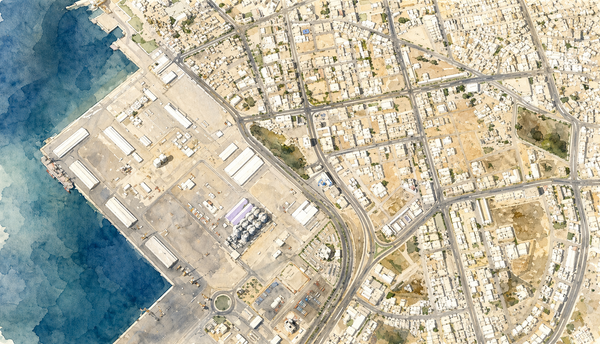
There are imitators all around the world. King Abdullah Economic City, launched in 2005 along the Saudi Red Sea coast, was built across 185 square kilometers of desert with an intended population of two million people. As of 2024, it had managed to draw in around 10,000 residents. The port KAEC built is excellent. But the city around it is a practical ghost town with a very efficient harbor.
Sejong in South Korea was an administrative capital that never quite became a city. Naypyidaw in Myanmar is a capital of government buildings and wide empty highways that could comfortably host a Formula One race on its main boulevard.
Each of these places spent enormous money trying to reverse-engineer Shenzhen. Each of them failed.
Shenzhen Was Lightning in a Bottle
The shorthand on Shenzhen is that it succeeded because China gave it Special Economic Zone status, low taxes and the freedom to experiment. That is true, but Shenzhen was not fundamentally successful because of the policy. Rather, the policy is what unlocked the city's geopolitical singularity, specifically that Shenzhen had every possible structural advantage converging at the same moment.
Shenzhen was not simply adjacent to Hong Kong. It was plugged directly into the most sophisticated capitalist trading infrastructure in Asia from its first day of existence. Hong Kong provided the capital, the international business networks, the legal framework and the managerial talent. Shenzhen was China's first experiment in market economics, but it had the perfect training partner right next door, a British colony that had already been running a global economy for decades. No other planned city that has tried to replicate the Shenzhen model has had anything remotely like that adjacency.
Shenzhen also had political advantages. Shenzhen's SEZ status did not just mean tax breaks. It meant a total exemption from the logic of China's planned economy, personally sanctioned by Deng Xiaoping, at the very moment when China was reintegrating itself into the global economic order after decades of isolation. The city was not competing against other Chinese cities for investment. It was the only game in a country of a billion people that was allowed to play by different rules. Xiong'an is a special zone inside an economy that already has hundreds of them.
The third factor is the one that gets discussed less. Shenzhen did not attract workers so much as, like many Chinese cities, it merely absorbed them. The city was the escape hatch for an entire generation of rural Chinese at the historical moment when that generation was ready to leave, when decades of agricultural surplus labor had accumulated in villages across Guangdong and Hunan and Sichuan and when millions of people were desperate, ambitious and willing to build something from nothing. The city did not need a recruitment strategy. The people came because there was nowhere else to go. Even other Chinese cities were growing astronomically then. Shenzhen just grew more and attracted younger, more energetic and inventive workers. Many subsequent attempts to replicate Shenzhen have assumed that if you build it, the talent and industry and economic energy will simply materialize. Shenzhen worked because the talent had no other option.
Finally, manufacturing. While later cities have tried to brand themselves as finance hubs or technology parks, Shenzhen built factories. Lots of them. It became a key node of the global supply chain at the exact moment that supply chain was reorganizing itself around Chinese labor. The financial towers of Yujiapu were built for bankers who were already perfectly comfortable in Beijing and Shanghai and who had no reason to move to Tianjin. Shenzhen did not ask anyone to relocate voluntarily.
The Mirage of the City from Scratch
Planned cities are often showpiece projects whether they intend to be or not. In other words, they are architectural before they are economic. Someone decides there should be a city before they decide all the other things. The master plan, the rendering. Some even have sales showrooms. There is often a scientific logic to the organization of transit stops against neighborhood nodes that don't even exist yet. Population targets grabbed out of thin air. The mixed-use districts are exactly where they should be. The green corridors are proportioned correctly. The phasing schedule is realistic.
But cities are not actually just infrastructure projects that achieve population. They are the residue of economic activity, migration, political power and historical accident, compressed over time into built form. Lower Manhattan developed because that it was where the boats came in, which determined where the money was made, which determined where the lawyers and bankers and merchants needed to be, which determined where the restaurants and hotels and theaters opened to serve them, which over two centuries produced a neighborhood so dense with economic and cultural gravity that it essentially cannot be replicated on a blank piece of land.
Shenzhen is the closest thing the modern world has to an exception to that rule. And the reason it is an exception is that all the structural forces that normally take centuries to accumulate were delivered to it simultaneously by historical circumstance. The demand was already there in the form of millions of workers with nowhere else to go. The capital was already there in the form of Hong Kong. The political permission was granted by the most powerful figure in the country. The global manufacturing boom arrived at exactly the right time.
When Those Pieces Don't Exist, Failure Can Be Ugly
The cities that tried and failed to become Shenzhen are now in various stages of reckoning, and the outcomes are clarifying.
Some will be slowly forced into relevance by state power. Xiong'an is the clearest case. The Chinese government has enough institutional muscle to keep moving offices there, keep building infrastructure, keep incentivizing universities and SOEs to establish a footprint. Over 1,000 employees from Huaneng's headquarters and affiliated units had entered daily office operations in Xiong'an by late 2025, and more will follow. This is not organic city formation. It is the state manufacturing the preconditions for a city and then waiting to see if a city follows. It may work, over decades, at enormous ongoing cost, but it will not look like Shenzhen.
Others have found partial second lives through more modest means. Ordos, Inner Mongolia's infamous ghost city, has quietly pivoted toward energy infrastructure, betting its future on China's renewables expansion rather than the population growth that never came. That is not what China planned for Ordos, but at least it is something.
Yujiapu has no obvious pivot. Some financial institutions and government offices have moved in, preventing total abandonment, but the towers remain largely empty, a $50 billion lesson in the difference between building a financial district and building the financial ecosystem that makes a district viable. KAEC, at 10,000 people across 185 square kilometers, has better prospects through its port than through anything residential or commercial. Naypyidaw will remain what it is, which is a capital city nobody lives in by choice.
The world is not short of failed utopias. But it does need an honest account of why they fail, which is that the people who build them keep mistaking the physical city for the thing that makes a city work.
So How Do You Create Shenzhen After All?
When the next great planned city emerges, and it will, the question the press will ask is whether it looks like Shenzhen. The renderings will be impressive. The investment figures will be enormous. The political will behind it will be presented as the thing that changes the equation. We always default to assuming policy is the key.
But we should be paying more attention to the structural forces that made Shenzhen possible in the first place. Is there an organic population movement already underway that the city can intercept, or is the plan assuming it can generate one from scratch? Is the city positioned at a genuine economic intersection, or is it being built somewhere convenient for the government that funded it? Is there adjacent infrastructure and institutional capacity that the city can plug into from day one, or will it have to build all of that from scratch while also trying to attract the people who would have been the reason to build it in the first place?
The answer to those questions, for almost every planned city ever announced, is no, no and no.
Shenzhen worked because it was at the intersection of the right geography, the right political moment, the right migration pressure and the right global economic shift. That intersection was stumbled into. Forty years of attempts to recreate it have produced some interesting infrastructure, a great deal of wasted capital and a growing global inventory of towers with nobody in them.
You cannot plan a miracle. You can only build a stage.