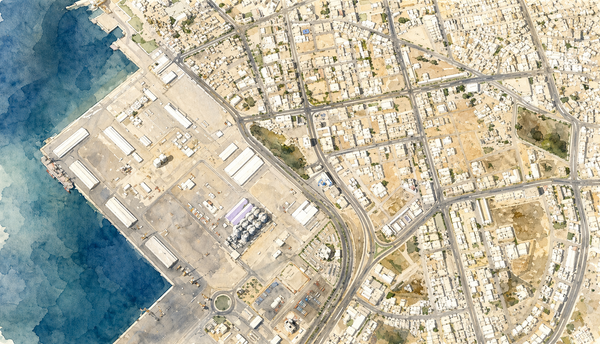
Yujiapu
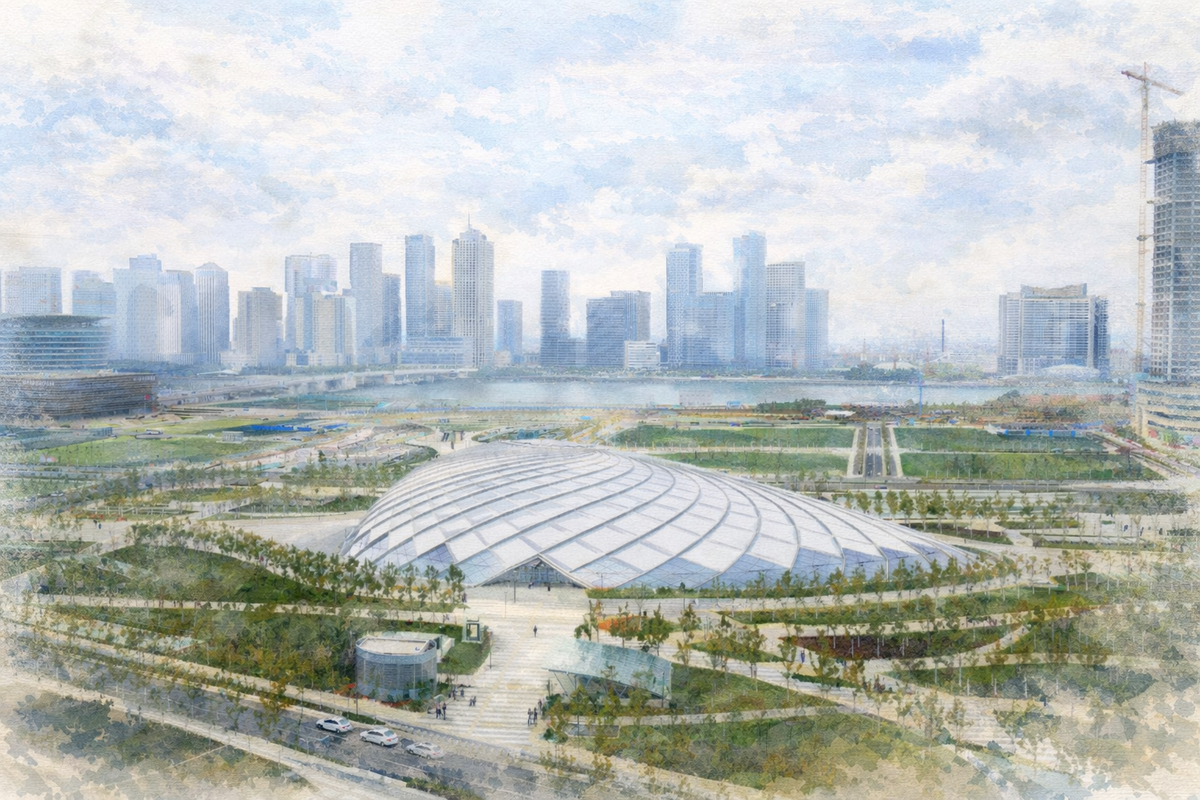
Every era of great economic ambition produces its ghost cities, and China's has produced more than most. Yujiapu is among the most instructive. Launched in the 2000s as part of Tianjin's Binhai New Area, it was conceived with the kind of confidence that looks either visionary or delusional depending entirely on whether it works. The pitch was straightforward and enormous: build China's Wall Street. Not a financial district that might one day compete with Shanghai's Lujiazui, but one designed from the ground up to do exactly that, complete with a dense skyline of gleaming towers, modern infrastructure, and high-speed rail connections to Beijing close enough to make the commute genuinely viable. On paper it was compelling. On the ground it became something else.
The towers went up. The tenants did not follow. Financing problems slowed construction, economic returns materialized more slowly than the projections had promised, and Yujiapu acquired the particular melancholy of a place built for a future that hasn't arrived yet. Half-finished skyscrapers. Underutilized office space. The infrastructure of a thriving financial capital standing largely empty, waiting for the density and activity that were supposed to justify its existence but that no amount of construction can conjure on its own.
What makes Yujiapu worth taking seriously rather than simply cataloguing as a cautionary tale is the underlying logic, which was never wrong. China's financial activity is heavily concentrated in Beijing and Shanghai, and the case for decentralizing it into other major cities is sound. The problem was never the destination. It was the assumption that you could build the destination first and let the journey figure itself out. That is a mistake planned cities make with remarkable regularity, and it is a more forgivable error in a country moving as fast as China has been than it would be anywhere else. Whether Yujiapu eventually grows into its ambitions or remains a skyline in search of a city is still being written.
Yujiapu is not a fully independent new city, but rather a financial district within Tianjin’s Binhai New Area. It was planned as China’s answer to Manhattan, designed to be a major financial hub with skyscrapers, corporate headquarters, and high-end commercial spaces. However, unlike a true new city, which would include comprehensive residential, industrial, and governance infrastructure, Yujiapu was mainly conceived as a business-focused district within the larger Binhai urban region.
Despite its ambitious vision, Yujiapu has struggled with delays, low occupancy, and financial challenges, leading to its reputation as a ghost city. While it remains part of Tianjin’s development strategy, it functions more as an underutilized commercial district rather than a self-sufficient city.
Yujiapu is one of China’s biggest real estate misfires, a ghost financial district that never became a true economic hub. Unless a major economic revival happens, it will remain one of the worst-planned urban experiments in China, a skyline without a city.
Strengths:
- Physically Built & Technically Functional: Yujiapu has skyscrapers, roads, and a high-speed rail station that connects it to Beijing and Tianjin.
- Government Still Trying to Revive It: Some financial institutions and government offices have moved in, preventing total abandonment.
- Prime Location (Theoretically): Situated near Binhai New Area, it was intended to be China’s financial capital outside of Shanghai.
Challenges:
- The “Manhattan of China” Hype Completely Flopped: Yujiapu was marketed as China’s answer to Manhattan but failed to attract major financial firms, leaving it mostly empty.
- Severe Overbuilding & Speculation: Similar to Ordos Kangbashi, developers built massive office towers without secured tenants, leading to empty buildings and financial losses.
- No Organic Economic Activity: Unlike Shenzhen or Pudong, Yujiapu never had a real industry driving growth, making it a hollow financial district without actual finance.
- Still a Ghost City: Many buildings remain unfinished, vacant, or poorly maintained, and the city’s skyline looks impressive but functions as a near-abandoned shell.
| Year - | Projected Working Population | Projected Residential Population | Actual Population |
|---|---|---|---|
| 2020 | 300,000 | 68,000 | Minimal |
| Year - | Event | Population Estimate |
|---|---|---|
| 2009 | Construction of Yujiapu Financial District commenced | N/A |
| 2014 | Initial completion target; construction delays reported | N/A |
| 2015 | Reports highlight the area as sparsely populated | N/A |
| 2019 | High-speed rail Yujiapu Station renamed to Binhai Railway Station | N/A |
| 2022 | Some government agencies relocated to Yujiapu | N/A |