Yanbu
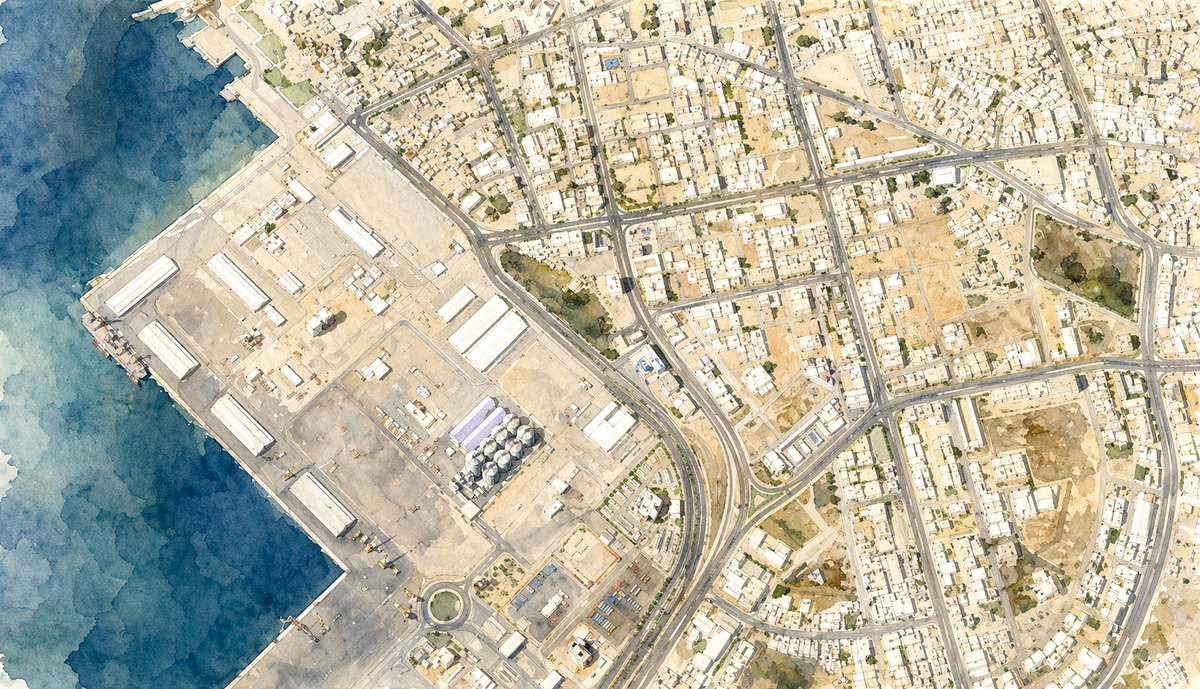
Yanbu doesn't get the attention that NEOM gets, or the architectural splashiness of the Red Sea Project, or the sovereign wealth fund swagger of Diriyah. It was developed under humbler pretenses for unglamorous entry in Saudi Arabia's urban portfolio, and arguably has been more successful than any of them. Established in the 1970s as a planned industrial city on the Red Sea coast roughly 300 kilometers north of Jeddah, Yanbu was built around a single organizing logic: put the refineries, the petrochemical plants, and the heavy industry close to the water and away from the population centers, and pipe the oil in from the eastern fields via the East-West Pipeline. Yanbu provided a practical solution to a practical problem, and it worked without fanfare and without anyone writing magazine profiles about it.
Yanbu is a serious industrial city of roughly 250,000 people, anchored by one of the largest petroleum refining and petrochemical complexes in the world. Saudi Aramco's footprint there is enormous. The port handles millions of tons of cargo annually. The industrial city that runs alongside the residential one has attracted manufacturers, chemical producers, and logistics operators for whom proximity to that infrastructure is critical. It is not a city that was built to be loved. It was built to be useful, and on that metric it has delivered consistently for half a century.
What will Yanbu become in a post-oil world that Saudi Arabia is at least nominally preparing for? Vision 2030 has touched everything in the Kingdom, and Yanbu is no exception. There are efforts to diversify its economic base, develop its coastline for tourism, and broaden its appeal beyond the industrial workforce that has defined it. Whether a city whose entire identity was forged in the petrochemical era can successfully reinvent itself is a question Saudi Arabia is asking about its entire national economy, and Yanbu is simply a smaller version of that challenge. It lacks NEOM's glamour and all of the same underlying pressure.
Yanbu can feel like a frontier new city because of its scale, isolation, and the degree to which the Royal Commission for Jubail and Yanbu effectively built a complete urban environment from scratch. But the distinction comes down to purpose and autonomy. Yanbu was conceived as a vertically integrated industrial platform anchored to petrochemicals, with housing and services designed to support that core economic engine. Frontier new cities, by contrast, aim for diversified, self-sustaining urbanism with multiple economic drivers and a broader civic identity from the outset. Yanbu is expansive and highly planned, but it remains fundamentally a specialized, export-oriented industrial district rather than a fully independent, multi-dimensional city.
Yanbu is not in the ghost-city bucket. It is one of Saudi Arabia’s real industrial success stories: a major Red Sea port and refining/downstream hub, still central to the Royal Commission’s industrial strategy. Recent Saudi reporting says Jubail and Yanbu remain the kingdom’s flagship industrial cities, and official/UNESCO material describes Yanbu Industrial City as a major contributor to Saudi industrial output.
Why not higher? Because Yanbu is more impressive as an industrial city than as a great urban place. It has residential areas, logistics infrastructure, and a functioning community, but it does not have the broader urban magnetism, diversification, or civic pull of the very top-tier new-city successes. The Royal Commission is still expanding residential and logistics infrastructure, which suggests it is successful but still maturing. It has, however, taken on renewed importance following the 2026 Iran War because it is the terminus and export hub for critical pipeline infrastructure.
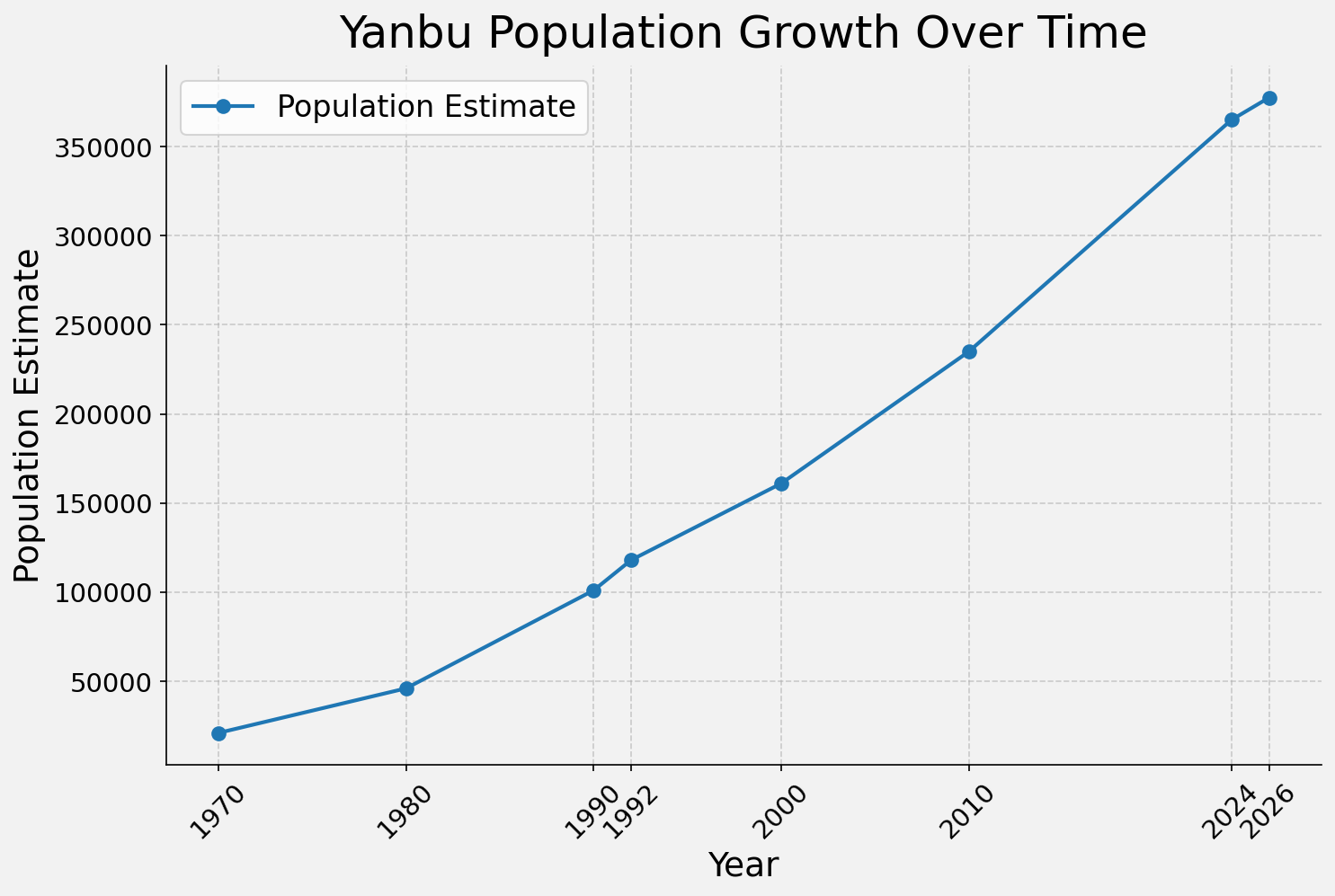
| Year | Population |
|---|---|
| 1970 | 21,000 |
| 1980 | 46,000 |
| 1990 | 101,000 |
| 1992 | 118,000 |
| 2000 | 161,000 |
| 2010 | 235,000 |
| 2024 | 365,000 |
| 2026 | 377,480 |
DISCLAIMER: The information presented across New Cities Atlas reflects approximate understandings of each city's development status, population figures, statistics, and trajectory, compiled from publicly available sources. It should not be taken as verified or definitive fact. New city developments are, by their nature, a moving target, and information is often scarce, frequently imprecise, and subject to rapid change as projects evolve, stall, accelerate, or are revised entirely. We are doing our best to build as comprehensive and accurate a picture as we can of a phenomenon that resists easy documentation, and we appreciate your understanding of the inherent limitations in that effort.
If you have up-to-date information about any of the cities featured here and would like to help us improve our coverage, we would genuinely welcome hearing from you. Reach us at newcitiesatlas@gmail.com.


