Wembley Park
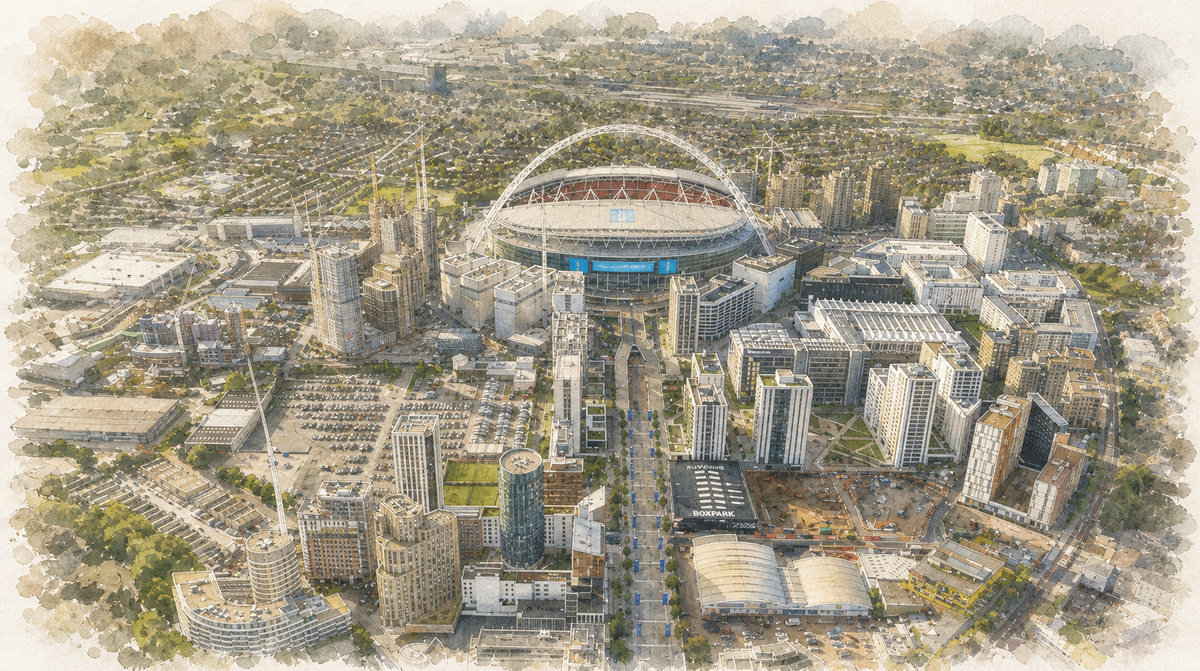
Wembley has been generating enormous crowds since 1923, when the original stadium was built as the centerpiece of the British Empire Exhibition. For most of the century that followed, the land around it was treated entirely as crowd infrastructure, including coach parks, surface parking, service roads. By the time the old stadium was demolished in 2003, the 85 acres surrounding it were among the most underleveraged parcels in Greater London: flat, well-connected by tube and rail, ten minutes from Marylebone, and almost completely inert except on match days.
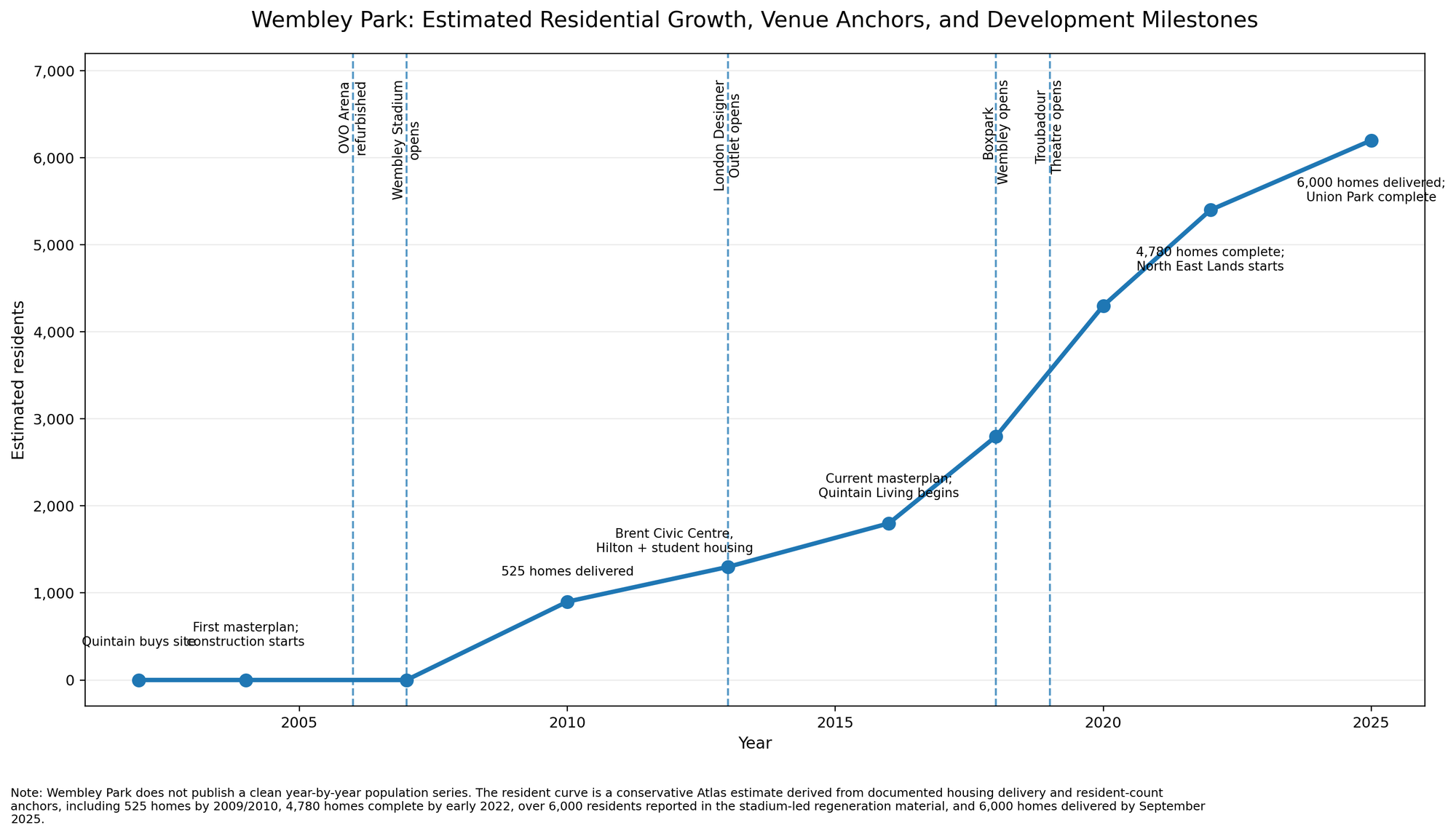
Quintain had begun assembling the land in 2002, acquiring approximately 44 acres of exhibition land and car parks around the National Stadium site before expanding its ownership to the full 85 acres through subsequent purchases. The timing was deliberate: Quintain recognized that the construction of the new Wembley Stadium, which reopened in 2007 with its landmark arch, would create a once-in-a-generation opportunity to anchor a major regeneration scheme around one of the most recognizable addresses in the world. The challenge was that Wembley had a global brand but a deeply local problem: the surrounding neighborhood in the London Borough of Brent was deprived, the immediate site was dead outside of events, and the history of failed regeneration attempts in the area meant there was justified skepticism about whether anything would stick.
Quintain's approach was to commit to the long term in a way that most developers do not. Rather than building out quickly and moving on, the company embedded itself as a permanent asset manager, building a vertically integrated operation that would own, manage, and programme the neighbourhood indefinitely. The first residents arrived in 2011. London Designer Outlet, the first outlet centre in London, opened in 2013. The SSE Arena Wembley (the old Empire Pool, built in 1934) was refurbished at a cost of £34 million and reoriented to open onto a new public square facing the stadium. Boxpark Wembley, the largest of the Boxpark sites, arrived later, along with the Troubadour Wembley Park Theatre. The transformation of Olympic Way, the famous processional route from Wembley Park station to the stadium, became the centerpiece of the public realm strategy: widened by 50 percent, repaved, lined with trees, and ultimately completed by the removal of the 1970s concrete pedway and its replacement with the Olympic Steps, which freed up over 12,000 square meters of new public space at the foot of the stadium.
Over £2 billion has been invested to date. The project is expected to reach 8,500 homes by 2027, when Quintain expects to complete what will be the largest single-site Build-to-Rent development in the United Kingdom.
Wembley Park is the most ambitious example of stadium-led urban regeneration in Britain, and one of the most significant in Europe. It is not primarily a sports district in the American sense, as in, a development that exists to extend the commercial footprint of a franchise. It is a new urban neighborhood that uses two major entertainment venues as anchors but is fundamentally oriented around residential density, permanent community, and year-round placemaking.
The two stadium anchors are exceptional by any standard. Wembley Stadium holds 90,000 people and hosts the FA Cup Final, England internationals, Champions League Finals, and some of the largest concerts in the world. The OVO Arena Wembley holds 12,500 and is one of the busiest indoor music venues in Europe. Together they generate enormous episodic traffic, but Quintain's project is explicitly structured around the argument that traffic alone does not make a neighborhood, and that the real work is everything that happens between events.
The district is organized around four sub-zones along Olympic Way and the surrounding streets, each with its own retail and entertainment character, anchored on one end by the stadium and on the other by the tube station. Roughly half the 85-acre site will be open space when complete. The residential component, now approaching 6,000 homes, a third of which are affordable, is the structural spine. Around it sits London Designer Outlet, Boxpark, Troubadour Theatre, Fresh Arts (a community hub), a new NHS GP surgery that is now the largest in northwest London, independent cafes and restaurants along Olympic Way, and an increasingly dense program of cultural events managed by Quintain itself.
The use mix at Wembley Park is unusual in one important respect: residential is not a supporting element, it is the primary one. This distinguishes the development sharply from American sports districts, where residential is typically the last layer to arrive and the thinnest. Quintain made a strategic pivot relatively early from residential for sale to Build-to-Rent, which turned out to be transformative for the district's character. Build-to-Rent produces a managed, stable residential population rather than a transactional one: residents who stay longer, engage more with the neighborhood, and generate the kind of day-to-day urban activity that retail and hospitality depend on. The roughly 10,000 people now living in Wembley Park are not there because of the Packers or the Blue Jackets; they are there because the neighborhood functions as a neighborhood.
The entertainment layer, the two venues, Boxpark, the Designer Outlet, the theatre, the programming, handles the visitor economy that the stadium anchors generate. London Designer Outlet alone draws 7 million visitors a year independent of stadium events. Boxpark adds street food, events, and nightlife. The Troubadour stages productions from the National Theatre. Fresh Arts runs community programming for Brent residents. The cultural calendar includes Winterfest, an immersive light trail, outdoor concerts, markets, and art installations: content that Quintain commissions and manages as part of its long-term asset management strategy rather than outsourcing to tenants to figure out.
The result is that the distinction between gameday and non-gameday has become less meaningful than at almost any other stadium-adjacent development in the world. The district draws approximately 17 million visitors a year in total, the vast majority of whom are not attending a Wembley Stadium event.
Wembley Park's score places it firmly in the Full Ignition cohort as one of the most complete and sustained examples of stadium-led urban regeneration in the world. Anchored by the reconstruction of Wembley Stadium and reinforced by a steady sequence of complementary venues and destinations, the district has evolved from a fragmented, underutilized landscape into a dense, highly programmed mixed-use environment. Over two decades, development has compounded rather than plateaued, with thousands of homes delivered, a growing resident population, and a layered mix of retail, entertainment, office, and cultural uses that extend activity well beyond event cycles. Unlike many comparable districts, Wembley Park demonstrates continuous momentum across multiple phases, with each wave of investment reinforcing the next and expanding the district’s identity and reach. While it operates within an already global city rather than reshaping one outright, its consistency, scale of delivery, and ability to sustain growth over time establish it as a leading model for large-scale district urbanization.
Wembley Park's performance has been strong enough that it has become a reference case for stadium-led regeneration across Europe. The Sunday Times named it one of its Best Places to Live in 2025, a designation that reflects how thoroughly the development has shed the stigma that surrounded Brent and the Wembley area for most of the late twentieth century. The NHS surgery, the schools, the employment generated through apprenticeship schemes during construction, and the programming partnerships with Brent Council reflect a social value dimension that the project embedded from the beginning rather than bolted on as a planning obligation.
The remaining risk is one of scale and sameness. The sheer volume of Build-to-Rent residential: 8,500 units on a single site under unified management, raises legitimate questions about whether Wembley Park is becoming a neighborhood in any organic sense or a very well-managed branded estate. When one developer controls the housing, the retail, the cultural programming, the public spaces, and the event calendar, the result is coherent but also potentially brittle and somewhat homogeneous. The neighborhood's diversity and authenticity over the long term will depend on whether Quintain's stewardship continues to make room for the independent, the unexpected, and the ungoverned — the elements that characterize genuinely urban places but that are difficult to manage within a single ownership model.
At roughly the twenty-year mark, Wembley Park is approaching completion and beginning to be assessed rather than just built. By the metrics it set for itself, including homes delivered, visitors attracted, public realm created, community embedded, it has largely succeeded. Whether it has produced a neighborhood that will outlast Quintain's management in the way that real urban districts do is a question that the next decade will begin to answer.
Physical Design
Strengths
1. Olympic Way was treated as the district's spine, not just a access route. Widening it by 50 percent, removing the pedway, lining it with trees and active ground-floor uses, and terminating it at the Olympic Steps transformed a piece of crowd-management infrastructure into the organizing element of an entire neighborhood. Every good sports district needs one street that works this hard.
2. The arena was reoriented to face the neighborhood rather than the stadium. Flipping the SSE Arena's entrance to open onto a new public square rather than a service road was a small decision with large consequences: it created a second public anchor at the western end of Olympic Way and ensured that two major venues were in dialogue with each other rather than each facing inward.
3. Public realm was delivered at a scale that absorbs crowds without feeling like crowd management. Nearly half the 85-acre site will be open space on completion. The squares, gardens, and widened boulevards are sized for the tens of thousands arriving for a stadium event but designed for daily neighborhood life. Most stadium-adjacent developments get this ratio badly wrong in one direction or the other.
4. The pedway removal unlocked the district's east-west connectivity. The 1970s concrete pedway physically divided the eastern and western halves of the site. Its removal and replacement with the Olympic Steps stitched the two sides together and freed 12,000 square meters of ground-level space. It is a reminder that inherited infrastructure often defines what a district cannot become, and that removing it is sometimes the most consequential design act available.
5. Ground-floor uses were curated along the full length of the main pedestrian route. From Wembley Park station to the stadium base, Olympic Way now has continuous active frontage, including cafes, independent retailers, Boxpark, restaurants, so that the pedestrian journey is itself part of the experience rather than dead walking time. This is what separates a processional route from a thoroughfare.
Flaws
1. The residential towers are too tall and too uniform to read as a neighborhood. The Build-to-Rent blocks, while well-designed individually, repeat at a scale and consistency that produces a managed-estate quality rather than an urban grain. A more varied block typology mixing tower, mansion block, and lower-rise would have created a more legible street hierarchy and a less institutionalized character.
2. The street network beyond Olympic Way is thin. The district is heavily organized around a single spine with relatively weak cross-streets feeding off it. A finer-grained grid would distribute pedestrian activity more evenly, reduce the dependence on one corridor, and create the kind of secondary street life, the quieter back-of-house lanes and neighborhood streets, that makes a district feel inhabited rather than curated.
3. The Designer Outlet reads as an internalized mall despite its location. London Designer Outlet is commercially successful but its architecture turns inward in the way that retail centers always have, presenting a relatively blank edge to the street on several sides. A more porous ground floor with stronger visual and physical connections between the interior retail and the public realm outside would have reinforced rather than interrupted the pedestrian experience.
4. There is too little variety in tenure and building ownership within the residential offer. Unified Build-to-Rent ownership produces management coherence but sacrifices the physical variety, including the different ages of buildings, the individually owned shopfronts, the incremental adaptation over time, that gives urban neighborhoods their texture. Some blocks sold to different developers, or plots made available for smaller-scale development, would have introduced a grain the current masterplan lacks.
5. The cultural and community facilities are too concentrated rather than distributed. Fresh Arts, Troubadour, Boxpark, and the main event programming are all clustered along Olympic Way. The residential areas to the west and south have fewer of these activating elements close at hand, which means that the further from the stadium spine you live, the more the neighborhood feels like housing rather than a district. Distributing community anchors, even small ones, through the residential fabric would have tied the whole together more convincingly.
DISCLAIMER: The information presented across New Cities Atlas reflects approximate understandings of each city's development status, population figures, statistics, and trajectory, compiled from publicly available sources. It should not be taken as verified or definitive fact. New city developments are, by their nature, a moving target, and information is often scarce, frequently imprecise, and subject to rapid change as projects evolve, stall, accelerate, or are revised entirely. We are doing our best to build as comprehensive and accurate a picture as we can of a phenomenon that resists easy documentation, and we appreciate your understanding of the inherent limitations in that effort.
If you have up-to-date information about any of the cities featured here and would like to help us improve our coverage, we would genuinely welcome hearing from you. Reach us at newcitiesatlas@gmail.com.