Titletown USA
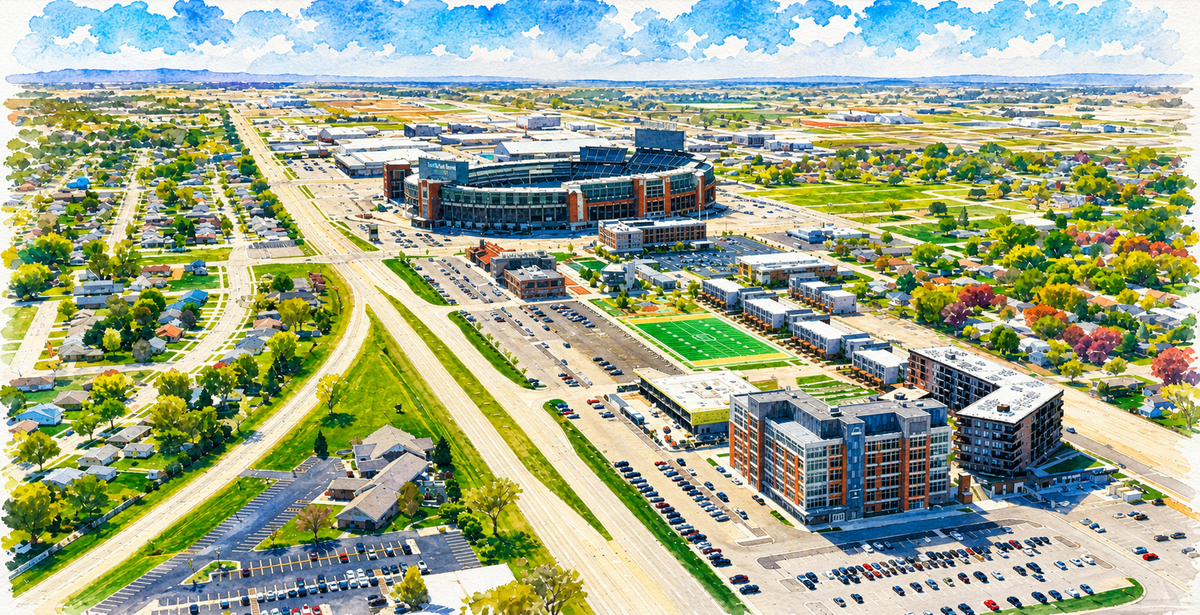
The land immediately west of Lambeau Field had never been much. By the time the Packers began buying parcels in the early 2000s, the roughly 34 acres adjacent to the stadium consisted of a gas station, a motel, and a lot of surface parking, the kind of forgettable buffer zone that accumulates around stadiums in secondary markets that never imagined they needed anything more. The Packers held the land for years without a clear plan for it. The vision came into focus around 2015, when team president Mark Murphy visited Patriot Place in Foxborough and came away dissatisfied. A mall next to a stadium, he concluded, was not the right model. Green Bay deserved something more rooted, more reflective of the community that had sustained the franchise for a century.
What the Packers announced that August was, by their own description, "one of the most aggressive real estate developments in all of professional sports." The ambition was deliberate. Green Bay is the smallest market in the NFL by a considerable margin: a city of roughly 110,000 people anchored by a franchise that the community has owned through public shareholders since 1923. The question the Packers were trying to answer was whether that franchise could do what major-market teams take for granted: generate year-round economic activity in a place where the entire regional identity is tied to seventeen home games a season. The Titletown District was the bet that it could.
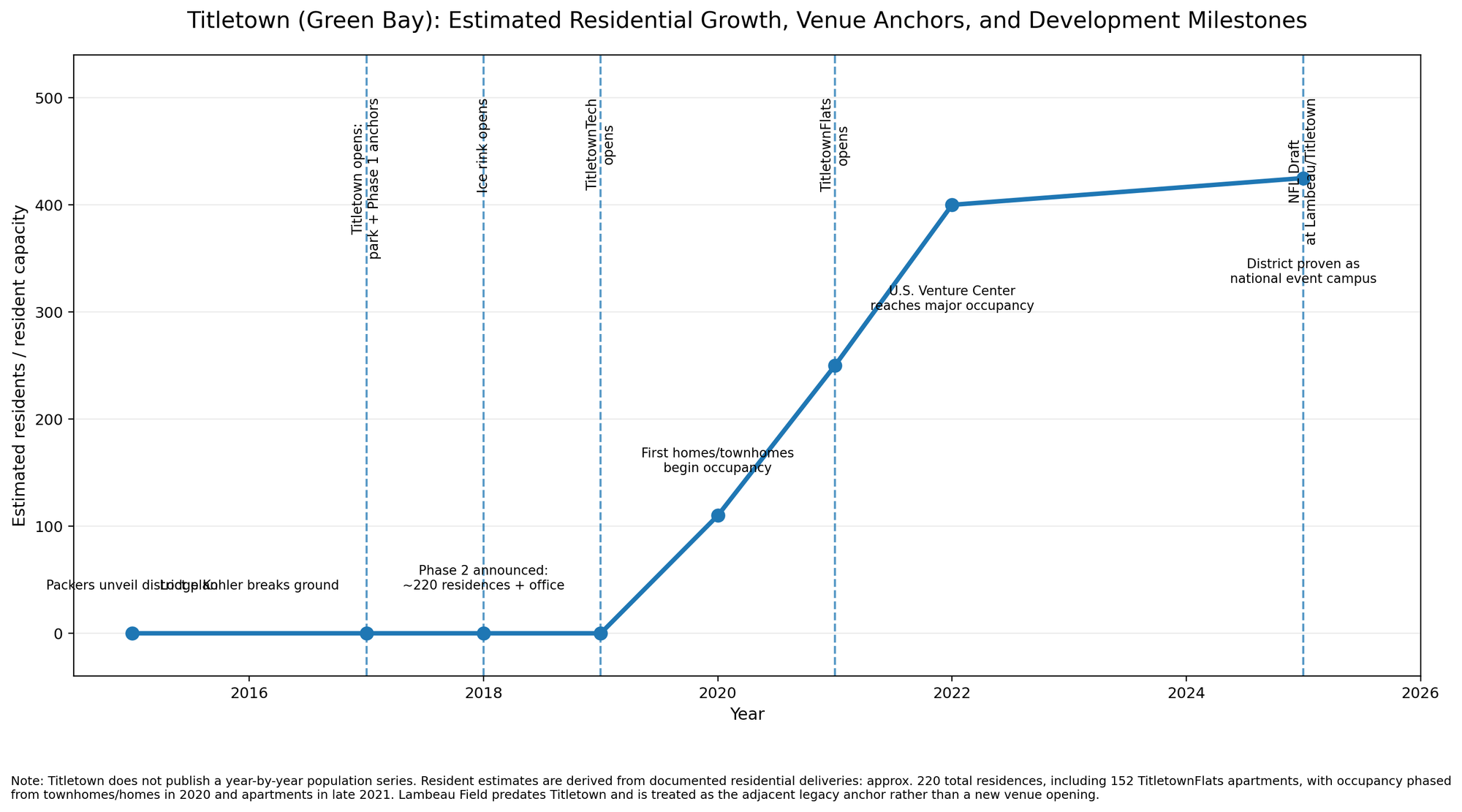
Phase one opened in 2017, built around a 14-acre public park and plaza designed by Rossetti with landscape architecture by Design Workshop. The Lodge Kohler hotel opened the same year, as did the Bellin Health sports medicine clinic and Hinterland Brewery and Restaurant. In 2018 the Packers added a seasonal skating rink and Ariens Hill, a 45-foot tubing run that became immediately and unexpectedly popular, drawing residents and visitors throughout Wisconsin's long winters. TitletownTech, a venture capital partnership between the Packers and Microsoft, launched in 2019 and took up residence in its own building on the site. Phase two, approved by the Ashwaubenon village board in late 2018, added residential and office components: approximately 220 units across an apartment building and townhomes, and the U.S. Venture Center, a seven-story office tower. Construction on those elements proceeded from 2019 onward.
Titletown is a different animal than other sports districts like Columbus's Arena District. It is not a multi-sport district built around the density of professional franchises. It is a community amenity district built around a single team with a singular relationship to its city: an attempt to convert the intense but episodic energy of NFL game days into a year-round urban fabric in a market too small to sustain that fabric through sports attendance alone.
The 45-acre site sits immediately west of Lambeau Field in Ashwaubenon, a village that is technically a separate municipality from Green Bay but functions as part of a continuous urban fabric around the stadium. The district is anchored on one end by the stadium itself and organized around the public park, which serves as the social and recreational core. Around it sits the Lodge Kohler (a four-diamond hotel that draws visitors independent of the football schedule), Hinterland, Bellin Health, TitletownTech, the U.S. Venture Center, Topgolf Swing Suites, Associated Bank, and the residential component. The Greater Green Bay convention campus, including the Resch Center arena and Resch Expo, a 125,000-square-foot facility that opened in 2021, sits on the eastern side of Lambeau Field, forming with Titletown a kind of campus bracketing the stadium on both sides.
What is conspicuously absent, by design, is the density of commercial entertainment uses that characterizes most sports districts. There is no cluster of sports bars. The retail presence is modest. The district is quiet on most days of the year in a way that more mixed-use districts are not, and the Packers appear to have accepted that tradeoff.
Titletown's score reflects a strong, clearly executed example of anchor-led district development that has successfully translated vision into place. Built adjacent to Lambeau Field and led by the Green Bay Packers, the district has moved quickly from concept to reality, layering in public realm, residential, office, and innovation uses in a coherent and highly legible way. Key elements such as TitletownTech and new housing have created a setting that functions beyond game days, establishing a genuine, if still compact, mixed-use neighborhood. While its scale remains modest and its long-term growth trajectory is still emerging, Titletown stands as a compelling model of how a legacy sports anchor can be leveraged to catalyze thoughtful, well-paced urban development in a smaller market context.
Titletown has exceeded what most observers expected when it was announced, particularly given the market it operates in. The district drew an estimated 600,000 visitors during the 2025 NFL Draft, an event Green Bay had been denied repeatedly before Titletown's development gave the city the infrastructure to make the case, generating an estimated $90 million in economic impact for Wisconsin. That single event produced the equivalent of three consecutive Packers home-game weekends. It would not have been possible without the district.
The Green Bay metro area was ranked the number one place to live in the United States by U.S. News and World Report in 2023, a designation that reflects factors well beyond Titletown but that the district's advocates cite as evidence of the broader quality-of-life shift the development has contributed to. TitletownTech's investment activity has begun generating genuine economic momentum in the region's technology and innovation sector, with the Microsoft AI Co-Innovation Lab partnership announced in 2024 extending the initiative's reach to UW-Milwaukee and positioning Green Bay within a statewide innovation ecosystem it could not have claimed membership in a decade ago. The Buffalo Bills visited Titletown in 2025 while developing their own Orchard Park stadium district plans, a signal that the development has achieved the status of a reference case in NFL circles.
The qualifier is that Titletown's success is inseparable from the singular cultural status of the Packers in Green Bay. No other franchise has the community ownership structure, the century of civic identity, or the pilgrimage economy that Lambeau Field generates. The district works partly because the team is, in a meaningful sense, the community's team, and the community therefore engages with it differently than fans engage with privately held franchises in larger markets. That context is not fully replicable elsewhere, and any designer studying Titletown needs to account for it.
Titletown is still in its growth phase. The original park and hotel opened in 2017; the residential and office components came online between 2019 and 2022; the U.S. Venture Center reached significant occupancy in 2022. The district is approximately eight years old, young enough that its full residential and commercial density has not yet been established. There are multiple potential sites for future development within the 45-acre footprint, and the district's boundaries continue to be understood expansively as the stadium campus on both its western and eastern sides matures.
The 2025 NFL Draft was, in some respects, Titletown's coming-out event. What comes after that is the slower, less glamorous work of filling in the remaining development sites, deepening the residential community, and sustaining TitletownTech's momentum through investment cycles that will not always be favorable. The district's long-term question is whether the innovation economy component can generate enough endogenous activity to make Titletown a genuine urban district rather than an exceptionally well-programmed sports campus. That outcome is plausible. It is not yet proven.
Five physical design strengths
- The park as the organizing element. Placing a 14-acre public park at the center rather than a parking field or commercial spine was an unconventional choice that paid off. It gives the district a genuine civic heart that works independent of any commercial transaction, and it creates a reason to be there on a Tuesday in January.
- The tubing hill. Ariens Hill is a small but brilliant piece of place-specific design — a 45-foot sledding run that turns Wisconsin's brutal winters from a liability into an asset. It draws residents who have nothing to do with football and activates the district during the dead months of the NFL offseason.
- Lambeau Field as a terminal vista. The district is organized so that the stadium reads as a backdrop and destination from within the park. The relationship between the open public space and the iconic building behind it gives Titletown a sense of place that most stadium-adjacent developments completely fail to achieve.
- Materials and design guidelines rooted in the local. The Rossetti-led design guidelines specified brick, local limestone, wood, and galvanized steel: materials tied to the region's industrial history rather than the generic glass-and-steel palette of most sports districts. The result is a district that feels like it belongs somewhere specific.
- The public realm is free and accessible. The park, the football field, the skating trail, the programming: none of it is ticketed or gated. This is a physical design decision as much as a policy one; the spaces were designed to invite rather than filter, with open edges and generous access points rather than the fenced perimeters that plague most stadium campuses.
Five physical design flaws
- The district is too shallow in the east-west direction. At 45 acres arranged essentially as a single band west of the stadium, Titletown lacks the depth to build a real street network. There is one main pedestrian axis and not much behind it, which limits how the district can grow and means that activity doesn't distribute across multiple routes.
- The hotel sits too prominently. Lodge Kohler is a handsome building, but its placement gives it an outsized visual presence that makes the district feel more like a resort campus than an urban neighborhood in certain views. A more embedded, less freestanding position would have helped it read as part of a district rather than the centerpiece of one.
- Retail and dining density is too thin. There simply isn't enough ground-floor commercial activation to sustain pedestrian life between the park and the other anchors. A visitor on a non-event weekday will find the edges of the district notably quiet. More active frontage distributed across more of the perimeter would address this.
- The residential component is under-scaled for the footprint. Roughly 220 units across a 45-acre district is not enough permanent population to animate the streets at off-hours. The townhomes in particular are sited in a way that feels suburban rather than urban — detached from the pedestrian energy of the park rather than reinforcing it.
- The transition to the surrounding neighborhood is abrupt. Where Titletown ends, the generic commercial fabric of Ashwaubenon begins without much mediation: chain restaurants, auto-oriented retail, surface parking. The district made no serious attempt to stitch itself into or upgrade its immediate surroundings, leaving it as an island of intentional design in an otherwise unremarkable suburban corridor.
DISCLAIMER: The information presented across New Cities Atlas reflects approximate understandings of each city's development status, population figures, statistics, and trajectory, compiled from publicly available sources. It should not be taken as verified or definitive fact. New city developments are, by their nature, a moving target, and information is often scarce, frequently imprecise, and subject to rapid change as projects evolve, stall, accelerate, or are revised entirely. We are doing our best to build as comprehensive and accurate a picture as we can of a phenomenon that resists easy documentation, and we appreciate your understanding of the inherent limitations in that effort.
If you have up-to-date information about any of the cities featured here and would like to help us improve our coverage, we would genuinely welcome hearing from you. Reach us at newcitiesatlas@gmail.com.