The Arena District, Columbus
The Ohio State Penitentiary, one of the oldest continuously operating maximum security prisons in the country, had sat shuttered and crumbling on prime downtown land since 1984. By the mid-1990s its outer walls were literally dropping debris onto parked cars. The city owned the site and had been courting redevelopment proposals for over a decade without landing one. Columbus was, at the time, the largest city in the country without a downtown arena.
The catalyst arrived in 1997 when Columbus was awarded an NHL expansion franchise, contingent on having an arena ready by the fall of 2000. The city put a sales tax levy to voters to finance a public arena. It failed. At that point Nationwide Insurance's CEO, Dimon McFerson, offered to privately finance the arena and the district around it, framing it as "a once-in-a-generation opportunity" to anchor a downtown that was stagnant. Within weeks of the levy's failure, Nationwide Realty Investors was in front of Columbus City Council with a full proposal. The city sold them 23 acres of the penitentiary site for $11.7 million. NRI picked up another four adjacent acres from AEP. Ground broke in May 1998. Nationwide Arena opened in September 2000, in time for the Blue Jackets' inaugural season.
The Arena District is a master-planned, mixed-use urban neighborhood built from scratch on a brownfield site adjacent to downtown Columbus. From the beginning, NRI's explicit goal was to build something that functioned as a neighborhood that would generate activity 365 days a year, not just on game nights. The original 75-acre footprint has since expanded to roughly 200 acres as surrounding parcels developed in response to the district's gravity.
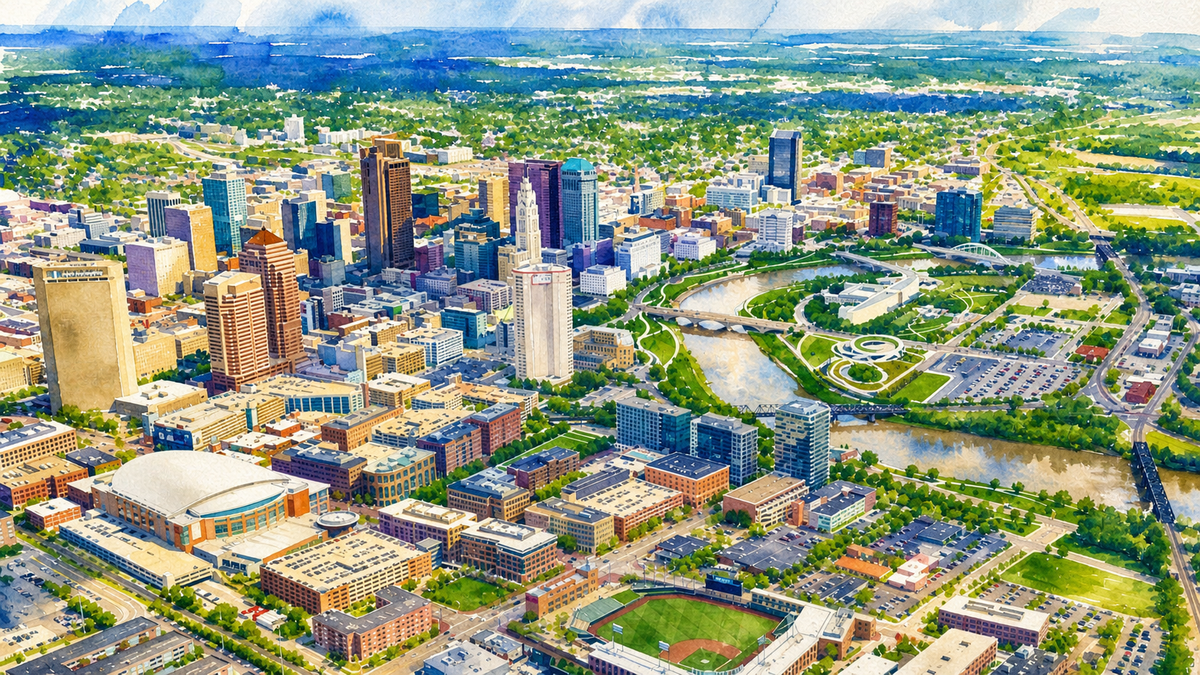
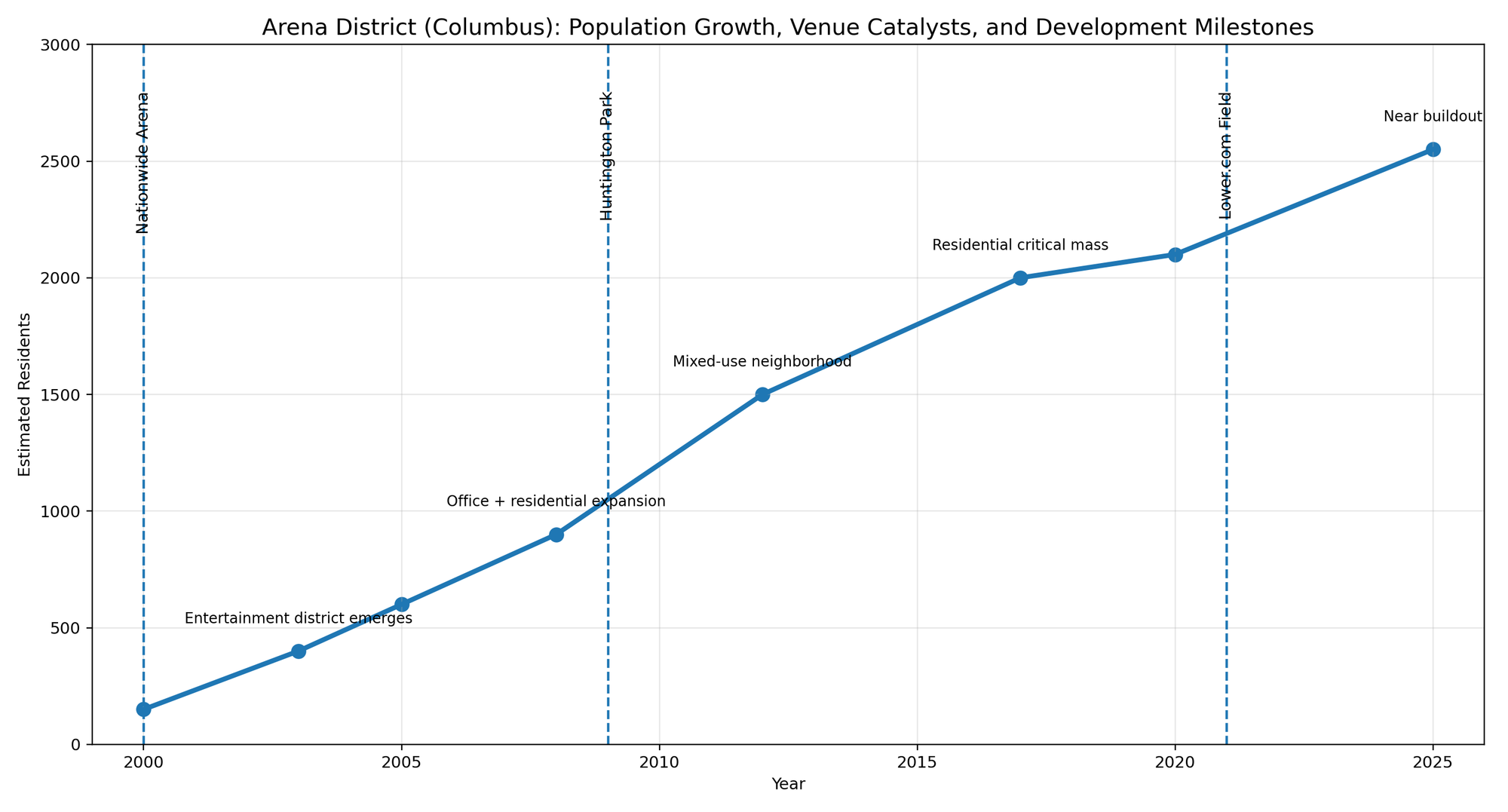
At its core are three professional sports venues within walking distance of each other: Nationwide Arena (NHL, 20,000 seats), Huntington Park (AAA baseball, 10,100 seats), and Lower.com Field (MLS, 20,371 seats). Around them sits 2.5 million square feet of office space, including Nationwide Insurance's own headquarters and Columbia Gas of Ohio, which provides the weekday daytime density that sustains the restaurants and retail. There are over 1,200 residential units across multiple phases, a 300,000 square foot retail and restaurant base, KEMBA Live! (an indoor/outdoor concert venue), the Arena Grand Theatre, a Hilton hotel, McFerson Commons park, Battelle Plaza, and a series of fan plazas connecting the venues along a pedestrian spine on Nationwide Boulevard. The Greater Columbus Convention Center anchors the eastern edge. The Short North arts district and North Market sit just beyond the northern boundary, creating a contiguous entertainment zone across much of downtown.
The Arena District in Columbus represents a tightly executed, high-performing example of urban district creation, even if it is just that – a district. Anchored by Nationwide Arena and reinforced over time by Huntington Park and Lower.com Field, the district followed a clear and effective trajectory from underutilized rail yards to a fully integrated mixed-use neighborhood. Its growth has been steady, intentional, and mostly free of major setbacks, with residential, office, and entertainment uses layering in a way that created real day-to-day urban life rather than a single-purpose destination. While it does not operate at the metropolitan or global scale of the highest-scoring cities, it stands as one of the cleanest and most replicable models of private-sector-led urbanization in the United States, demonstrating how targeted catalytic investments can drive sustained and coherent district-level growth over time.
The Arena District is mature but not finished. The original 75-acre build-out was essentially complete by 2014. The opening of Lower.com Field in 2021 and the launch of the adjacent Astor Park neighborhood represent the district's third major chapter, extending its western edge and adding a third professional sports anchor that brought new energy and a new fan base into the district. Astor Park, which is still under construction, will add additional office and residential density around the soccer stadium, essentially replicating the original Arena District logic at a new node within walking distance of the original core.
The central challenge at 25 years is Nationwide Arena itself. The building is aging. Its infrastructure needs significant investment to remain competitive for top-tier events, and its fan amenities are behind what newer arenas offer. The Franklin County Convention Facilities Authority, the public body that has owned it since 2012, is advancing a $400 million renovation plan structured as a public-private financing stack: up to $100 million in state grants from a sports facility fund, over $100 million in public bonds, $25 million each from the city and county, and $100–140 million in private contributions from Blue Jackets ownership and other partners. Columbus City Council approved the framework unanimously in December 2025. Major construction is projected to begin in 2027 and conclude around 2030. The renovation is not optional if the district is going to remain what it has been. Letting the anchor venue age out would undermine the entire ecosystem that depends on it.
The bigger picture, though, is that the Arena District has now been operating long enough to be studied rather than just praised. Its core logic, including private financing, mixed-use master plan, office-anchored weekday density, multi-sport programming to cover the calendar, has influenced sports district development in cities across the country. It is the closest thing American urbanism has to a proven template for this building type, and Columbus has been in the business of executing it for nearly three decades.
Approximate growth trajectory:
Physical Design
Strengths
1. The street grid was preserved and extended, not erased. Rather than treating the site as a superblock — which is the default failure mode of stadium development — the Arena District maintained a legible street network with blocks of a walkable scale. Nationwide Boulevard functions as a genuine urban street with ground-floor activation, not a service road around a parking structure. This is what allows the district to connect to the Short North and downtown rather than sitting as an island.
2. The office component was built first and built large. Putting 2.5 million square feet of office in the district before the residential filled in gave the retail and restaurant base a Monday-through-Friday customer who wasn't there for a game. Most sports districts skip this or treat it as an afterthought. Columbus made it structural. It is the single biggest reason the district doesn't feel dead on a Wednesday in March.
3. Each venue has its own public realm. McFerson Commons, Battelle Plaza, the fan plazas at Lower.com Field, the pedestrian spine along Nationwide Boulevard — each anchor has an outdoor gathering space that spills activity onto the street before and after events. This means the energy of a game night is visible and accessible from the street, drawing in people who didn't buy a ticket.
4. The master plan was held but not rigidly. MKSK's original framework gave NRI enough structure to maintain coherence across 25 years and multiple market cycles, but NRI adapted when the market required it — converting planned office to residential in 2001 when the office market softened, expanding the footprint westward when the MLS stadium opportunity arose. The plan was a discipline, not a straitjacket.
5. The programming calendar was treated as infrastructure. Stacking NHL, AAA baseball, MLS, a major concert venue, and the Arnold Sports Festival wasn't accidental — it was a deliberate strategy to cover the calendar so that the supporting retail and restaurant base could survive on something other than 41 hockey nights. Most districts don't think about programming as a design input. Columbus embedded it in the development logic from the beginning.
Flaws
1. Parking dominates the western and northern edges. Despite the walkable core, the district is still ringed by a significant amount of surface parking and structured garages that create dead edges — particularly on the Neil Avenue side. For pedestrians arriving from the west, the experience of entering the district is hostile. A future designer should treat every parking structure as a temporary use with a plan for its eventual replacement, and push parking to the outermost edges with active ground floors on the garages from day one.
2. The residential density arrived too late and remains too low. With just over 1,200 units after 25 years across a 200-acre district, the Arena District has nowhere near enough permanent residents to sustain genuine neighborhood life independent of event traffic. The streets are not activated by residents on a Sunday morning the way a real neighborhood would be. More residential, delivered earlier and at higher density, would have accelerated the district's transition from entertainment zone to actual urban neighborhood.
3. The district has a single dominant owner, which is a resilience problem. Nationwide Realty Investors controlling most of the district has produced coherence and long-term thinking, which are real advantages. But it also means the district's character, programming, and pace of development are almost entirely dependent on a single institutional landlord's priorities and balance sheet. A future district should be designed for multiple ownership blocks from the outset so that no single owner's decisions can stall or redirect the whole.
4. Ground-floor retail is too event-dependent in its distribution. The concentration of restaurants and bars along Nationwide Boulevard means that when there's no event, the street is visibly quieter and some operators clearly struggle. The district needed more retail distributed across a wider street network — not just the main spine — to create multiple pedestrian routes with active frontage rather than one arterial that ebbs and flows with the event calendar.
5. Transit was never seriously solved. Columbus is a car-dependent city and the Arena District reflects that. There is no rail connection, bus service to the district is limited, and the result is that major events produce significant traffic and parking pressure that a future district cannot ignore. This was partly a Columbus-wide failure rather than a planning failure specific to the district, but a future designer in any comparable city should treat transit access as a non-negotiable condition of the program — not something to hope the transit agency eventually figures out.
DISCLAIMER: The information presented across New Cities Atlas reflects approximate understandings of each city's development status, population figures, statistics, and trajectory, compiled from publicly available sources. It should not be taken as verified or definitive fact. New city developments are, by their nature, a moving target, and information is often scarce, frequently imprecise, and subject to rapid change as projects evolve, stall, accelerate, or are revised entirely. We are doing our best to build as comprehensive and accurate a picture as we can of a phenomenon that resists easy documentation, and we appreciate your understanding of the inherent limitations in that effort.
If you have up-to-date information about any of the cities featured here and would like to help us improve our coverage, we would genuinely welcome hearing from you. Reach us at newcitiesatlas@gmail.com.