Milton Keynes
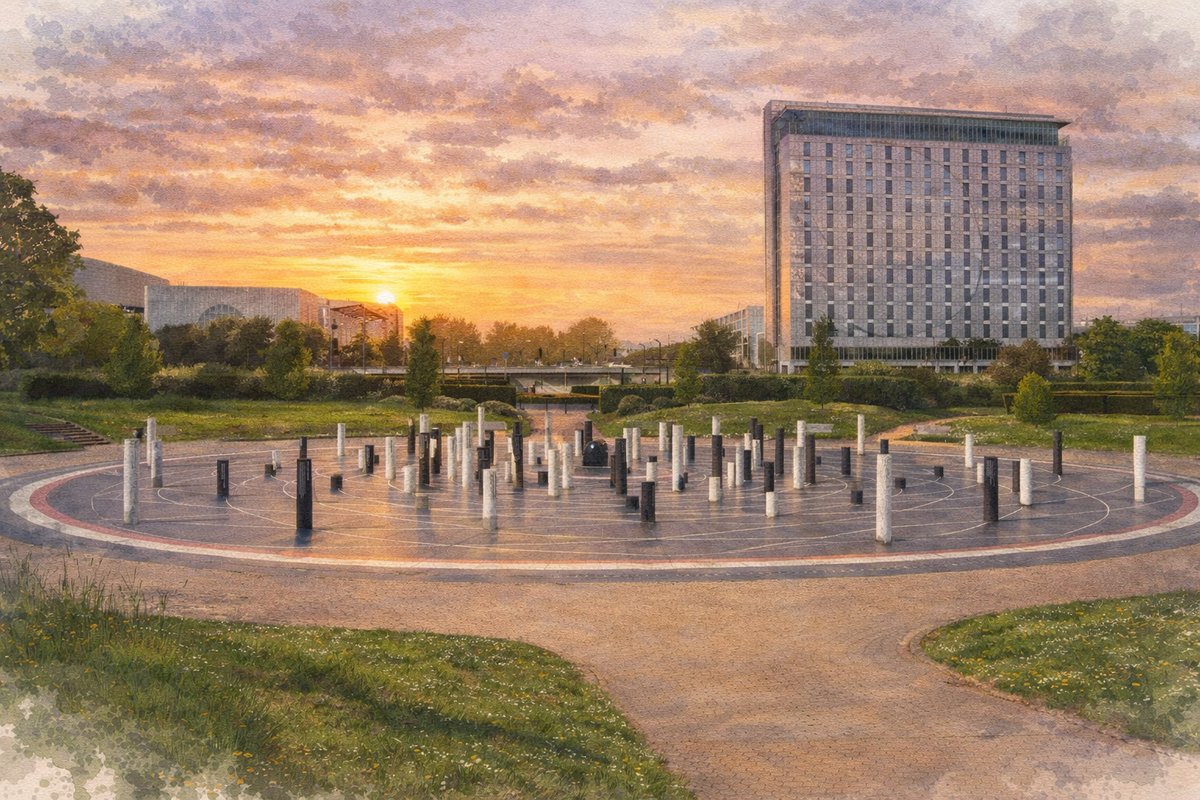
Milton Keynes is one of the most misunderstood cities in Britain, which is saying something for a country that has made an art form of misunderstanding it. The standard critique (grid roads, roundabouts, concrete cows, a soulless monument to the automobile) is the kind of lazy shorthand that gets repeated so often it has calcified into received wisdom. It is also mostly wrong. The car infrastructure was never really the point. It was the precondition that freed the actual idea: a city in which pedestrians and cyclists move through an entirely separate network of "redways," ribboning through green space and parkland, physically disconnected from the road grid entirely. The vision wasn't a city built around the car. It was a city in which the car was quarantined so that everything else could breathe.
What that made possible is genuinely creative urbanism that almost nobody gives Milton Keynes credit for. The downtown, Central Milton Keynes, is organized with an almost Japanese precision, segmented like a bento box into discrete use clusters: the shopping building, the entertainment building, the theatre, each in its own zone, modern and legible in a way that most British city centers, accreted haphazardly over centuries, simply are not. And then surrounding it, forty-five neighborhood squares, each roughly a kilometer by a kilometer, each lush and pastoral and walkable in a way designed to make residents forget they ever wanted to live in a big city. The mix of private housing estates alongside public ones was deliberate and ambitious, a social architecture as carefully considered as the physical one.
It worked. That's the part that stings the critics most. And now a generation of formulaic urbanists, armed with their densification manifestos and their transit-oriented talking points, want to retrofit Milton Keynes into something that looks like Bedford. The irony is exquisite: a city that was mocked for decades for being too radical is now under pressure to become more conventional. The people who never understood what Milton Keynes was trying to do have decided that the solution to its alleged failures is to undo its actual successes. Milton Keynes deserves better than that, and frankly, so does the conversation about what planned cities can be.
Milton Keynes is a true new city, though it does not officially hold city status in the UK. Established in 1967 as part of the UK’s post-war new town program, it was designed to accommodate London’s overspill population and create a modern, planned urban area. Unlike a district, which is an extension of an existing city, Milton Keynes was built from scratch on largely undeveloped land in Buckinghamshire, incorporating existing villages.
Designed with a grid road system, green spaces, and mixed-use development, it has grown into a major economic center with over 280,000 residents. While often called a "new town," its scale, governance, and urban independence make Milton Keynes a true planned new city.
Milton Keynes is one of the most successful new towns ever built, growing into a dynamic, economically strong, and highly livable city. While it still has car dependency and identity challenges, it has far exceeded the expectations of most planned cities worldwide.
Strengths:
- One of the UK’s Most Successful New Towns: Planned in the 1960s to decentralize growth from London, Milton Keynes has grown into a thriving city with over 285,000 residents.
- Strong Economic Base: Home to tech firms, logistics hubs, financial services, and retail giants, making it one of the fastest-growing economies in the UK.
- Excellent Transport & Connectivity: Located midway between London and Birmingham, with fast rail connections, major motorways (M1), and a planned future East-West Rail link.
- High Quality of Life: Features well-designed parks, walkable districts, and a strong housing market, appealing to families and professionals.
- Sustained & Organic Growth: Unlike many planned cities, Milton Keynes has continuously evolved, adapting to new economic and social trends.
Challenges:
- The original plan prioritized grid roads and car dependency, making public transport weaker compared to older UK cities.
- Still Lacks Historic & Cultural Depth: While growing, Milton Keynes is often seen as functional rather than culturally rich, with fewer historic landmarks or a deep-rooted identity.
- Housing & Cost Pressures: As it succeeds, housing demand is rising, pushing up prices and making affordability an emerging issue.
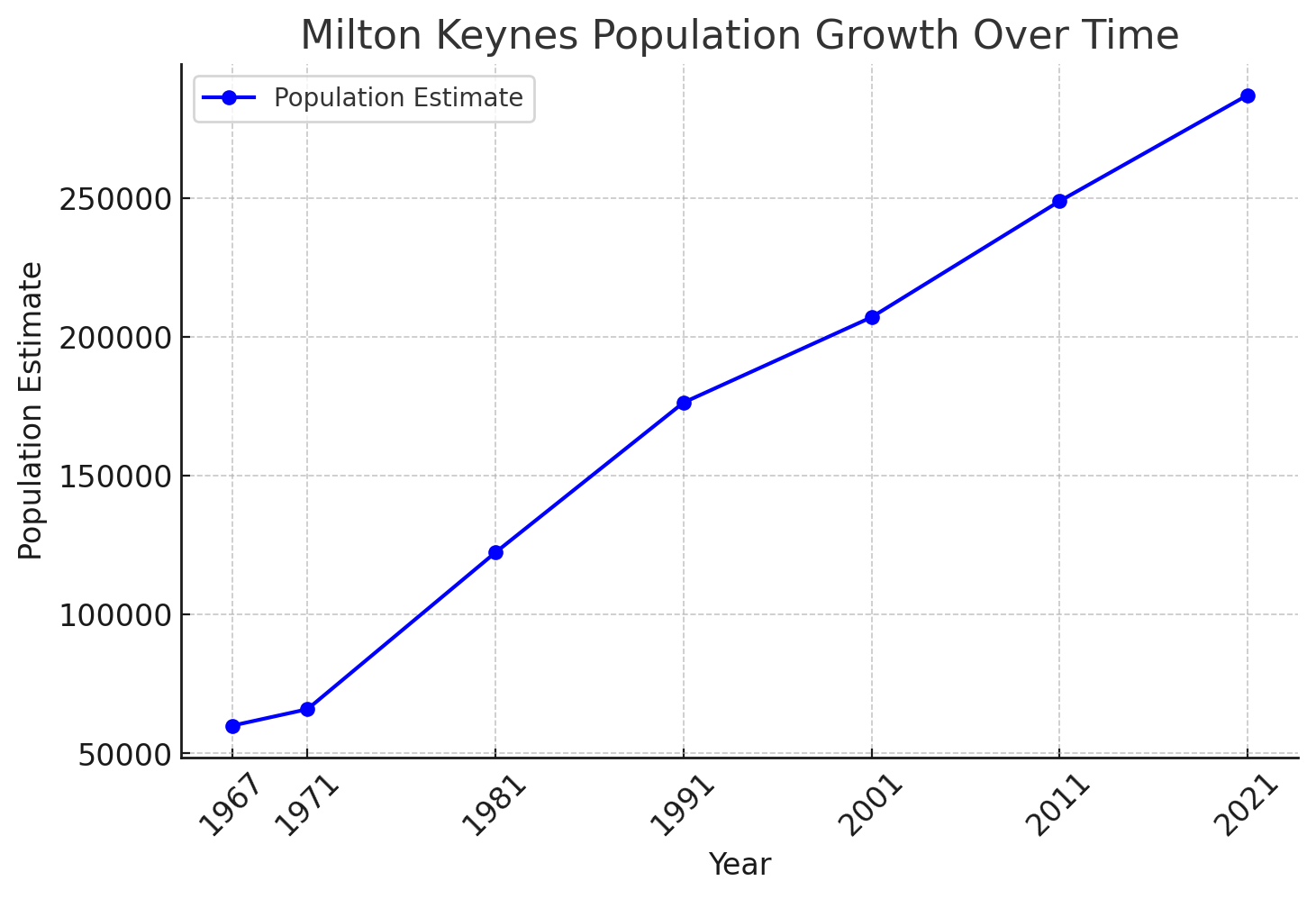
| Year | Event | Population |
|---|---|---|
| 1967 | Designation of Milton Keynes as a new town | ~60,000 |
| 1971 | First major housing scheme (Galley Hill, Stony Stratford) | ~65,925 |
| 1981 | Milton Keynes Central railway station opened | ~122,351 |
| 1991 | Church of Christ the Cornerstone completed | ~176,304 |
| 2001 | Xscape entertainment complex opened | ~207,037 |
| 2011 | Milton Keynes Theatre and Art Gallery opened | ~248,821 |
| 2021 | Milton Keynes granted city status | ~287,000 |
DISCLAIMER: The information presented across New Cities Atlas reflects approximate understandings of each city's development status, population figures, statistics, and trajectory, compiled from publicly available sources. It should not be taken as verified or definitive fact. New city developments are, by their nature, a moving target, and information is often scarce, frequently imprecise, and subject to rapid change as projects evolve, stall, accelerate, or are revised entirely. We are doing our best to build as comprehensive and accurate a picture as we can of a phenomenon that resists easy documentation, and we appreciate your understanding of the inherent limitations in that effort.
If you have up-to-date information about any of the cities featured here and would like to help us improve our coverage, we would genuinely welcome hearing from you. Reach us at newcitiesatlas@gmail.com.