Hope City
Hope City, a proposed high-tech hub in Ghana, was envisioned as West Africa’s answer to Silicon Valley. Announced in 2013, the $10 billion project aimed to create Africa’s tallest skyscraper, alongside technology parks, business districts, and residential areas. The city was expected to house 50,000 residents and provide jobs for 50,000 IT professionals, focusing on software development, hardware manufacturing, and telecom innovations. However, Hope City has struggled to materialize, facing funding issues, lack of investor confidence, and limited government backing. While Ghana continues to invest in tech infrastructure, the project remains largely stalled, highlighting the challenges of large-scale speculative urban developments in emerging economies without strong financial and institutional frameworks.
Hope City is best understood as a frontier new city, though largely unrealized. It was conceived as a ground-up, master-planned technology hub on the outskirts of Accra, intended to position Ghana as a regional center for IT, finance, and innovation. The project proposed iconic towers, dedicated infrastructure, and a new economic ecosystem independent from existing urban fabric. Unlike an urban expansion, it was not simply outward growth, and unlike a district, it was not meant to plug into Accra’s existing structure. However, delays, financing challenges, and shifting market conditions have stalled its realization. As a result, Hope City remains more of a speculative frontier vision than a functioning urban environment today.
Hope City scores 5 out of 100 on the Momentum Index because it never meaningfully moved from announcement to realization. It was launched as a planned $10 billion technology park at Prampram, intended to include major office space and what was billed as Africa’s tallest tower, but construction never truly got underway. Recent reference material still describes it as a planned project whose construction has yet to begin, with no new construction timeline set after Ghana’s economic downturn and the troubles surrounding RLG Communications.
On this index, that puts Hope City near the very bottom. It had vision, publicity, and symbolic ambition, but essentially no realized urban life, no functioning economic district, and no visible city-building momentum. Even years after the original announcement, outside commentary was already describing the project as deflated or effectively dead.
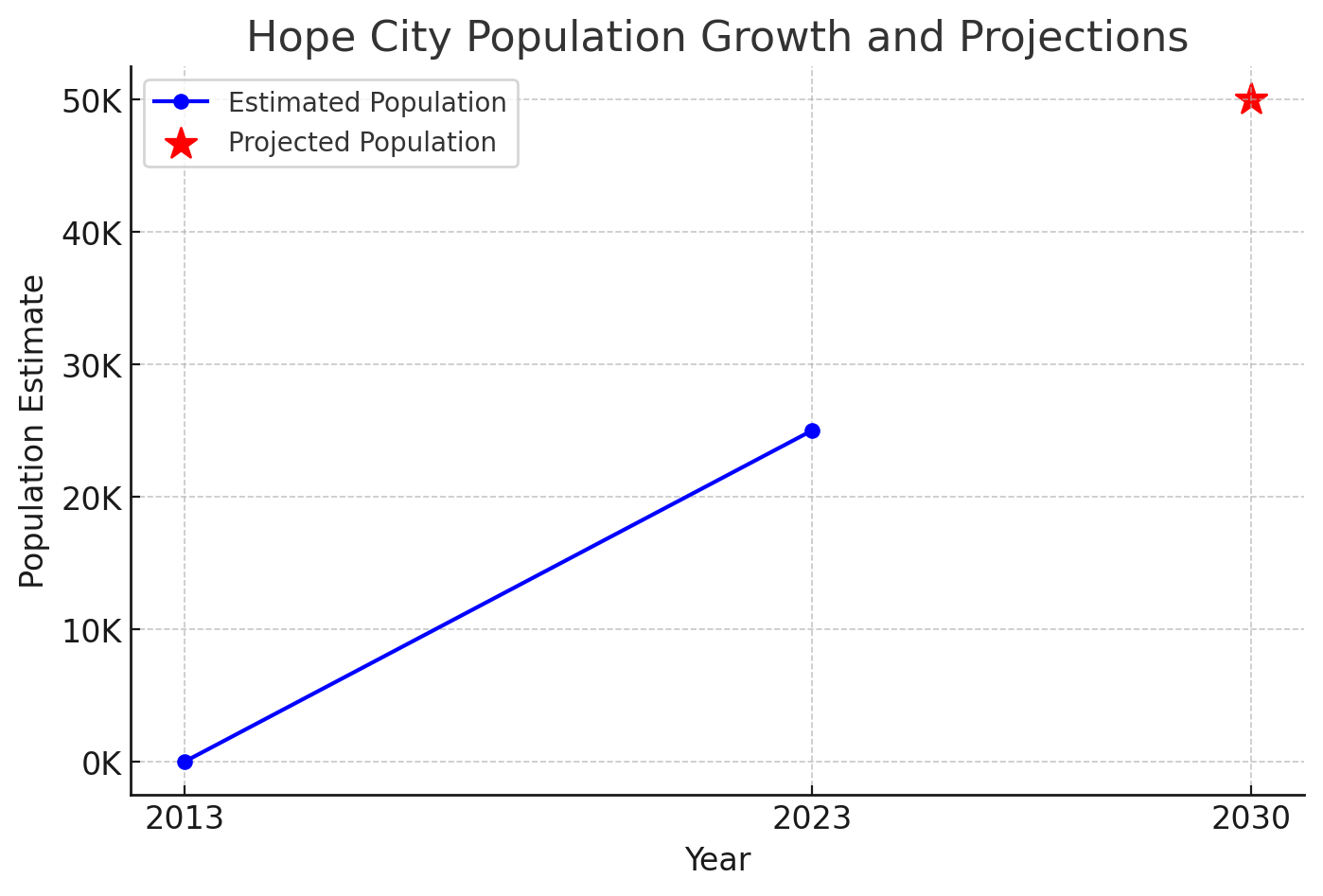
| Year | Population Estimate |
|---|---|
| 2013 | 0 |
| 2023 | >25,000 |
| 2030 | >50,000 |
DISCLAIMER: The information presented across New Cities Atlas reflects approximate understandings of each city's development status, population figures, statistics, and trajectory, compiled from publicly available sources. It should not be taken as verified or definitive fact. New city developments are, by their nature, a moving target, and information is often scarce, frequently imprecise, and subject to rapid change as projects evolve, stall, accelerate, or are revised entirely. We are doing our best to build as comprehensive and accurate a picture as we can of a phenomenon that resists easy documentation, and we appreciate your understanding of the inherent limitations in that effort.
If you have up-to-date information about any of the cities featured here and would like to help us improve our coverage, we would genuinely welcome hearing from you. Reach us at newcitiesatlas@gmail.com.