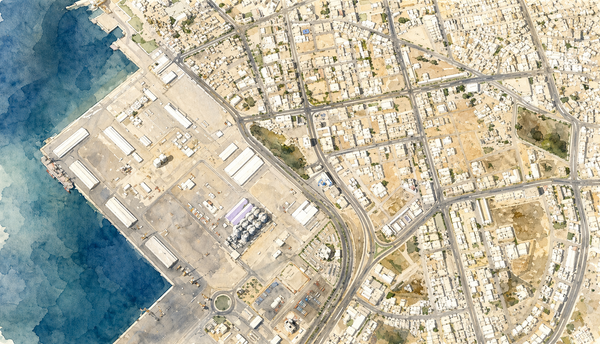
Ashburn Alley Data Center Ecosystem
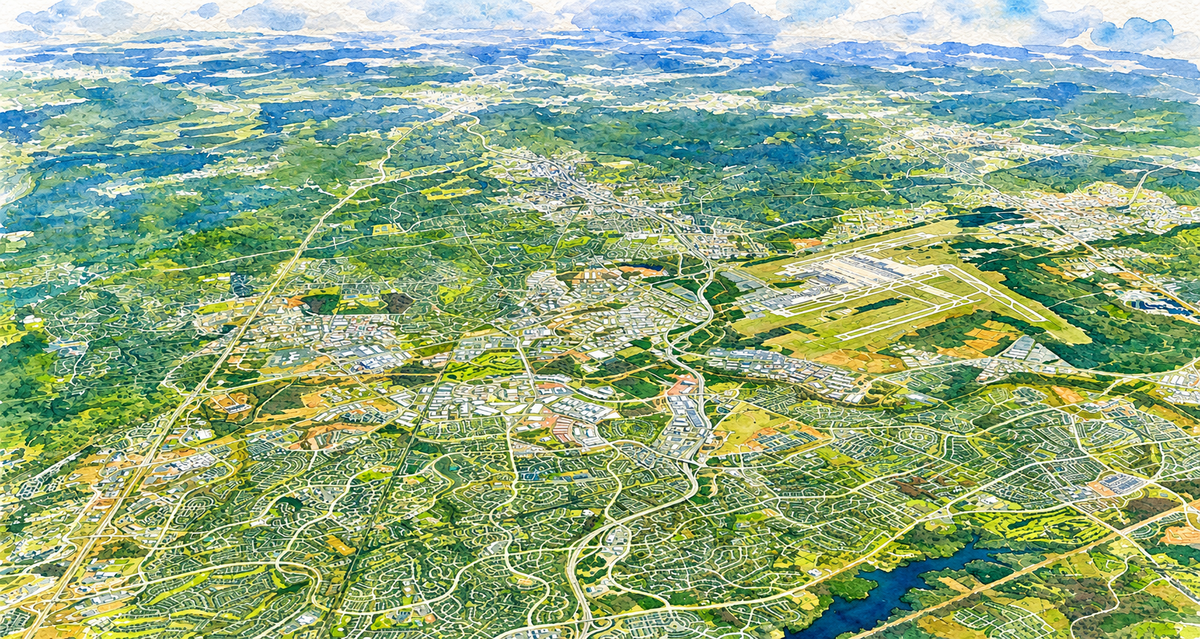
Core communities: Ashburn, Sterling, Leesburg, Loudoun County, Manassas, Gainesville, Haymarket, Prince William County, parts of Fairfax County.
Northern Virginia is the world’s leading data center cluster. The heart is Ashburn and eastern Loudoun County, but the development frontier has pushed south and west into Prince William County, especially around Manassas, Gainesville, Haymarket, and the proposed PW Digital Gateway corridor. Loudoun alone has roughly 200 data centers and more than 4 GW of data center load, while broader Northern Virginia has hundreds of facilities.
The scale of data center development in Northern Virginia is not just larger than other U.S. clusters, it is categorically different. Markets like Dallas-Fort Worth, Phoenix, and Atlanta are all experiencing rapid growth and now host hundreds of megawatts, even pushing into the gigawatt range, but Northern Virginia operates at a multi-gigawatt scale that no other region consistently matches. Loudoun County alone contains more data center capacity than many entire states, and the broader Northern Virginia cluster routes a substantial share of global internet traffic, making it less comparable to a typical “market” and more akin to a critical piece of national infrastructure. Other regions tend to function as fast-growing nodes, often driven by land availability or tax incentives, while Northern Virginia is a fully matured ecosystem where cloud providers, colocation firms, fiber networks, and power systems have all co-located at extreme density. The result is that while other cities are building data center districts, Northern Virginia has effectively become the center of gravity for the digital economy, with a scale, concentration, and embeddedness that still sets it apart from every peer market in the country.
Why Northern Virginia?
The original reason was network geography: MAE-East, AOL-era fiber, federal telecom infrastructure, and proximity to Washington turned Ashburn into one of the world’s densest internet exchange environments. That early advantage became self-reinforcing: cloud companies, colocation providers, fiber carriers, and power infrastructure all clustered there.
Key reasons for data centers here included fiber density and interconnection, proximity to existing cloud ecosystems, reliable power infrastructure, though now strained, large parcels in suburban industrial corridors, favorable tax treatment historically, proximity to federal, defense, cybersecurity, and enterprise demand, and network gravity. Plus, companies have located there because everyone else is already there.
Major companies involved
The most important players include:
Hyperscale / cloud: Amazon Web Services, Microsoft, Google, Meta.
Colocation / data center operators: Equinix, Digital Realty, QTS, Compass, NTT, Vantage, CyrusOne, CoreSite, Iron Mountain.
Northern Virginia’s top providers include AWS and Digital Realty, with Baxtel listing AWS at about 150 sites and Digital Realty at 37 facilities in the market.
Types
Northern Virginia contains the full spectrum of modern data center typologies, often layered within the same geographic cluster.
At the core are colocation and interconnection facilities, especially in Ashburn and Reston. These are highly network-dense buildings where multiple tenants colocate servers and connect directly to one another. Their value comes less from raw computing power and more from proximity to fiber routes and other networks. This is what makes Ashburn one of the most important exchange points on the internet.
Surrounding that is a vast landscape of hyperscale cloud campuses. These are large, purpose-built facilities operated by companies like Amazon Web Services, Microsoft, Google, and Meta. They are typically developed as multi-building campuses with standardized designs, long-term expansion capacity, and extremely high power demand. These sites are less about interconnection and more about delivering cloud services at massive scale.
A newer layer is emerging in the form of AI-oriented data centers. These facilities are designed for much higher power density per square foot, with different cooling requirements and significantly larger electrical loads. They are beginning to reshape site planning, with greater emphasis on substations, power redundancy, and thermal management systems.
There are also build-to-suit campuses developed for single tenants. These resemble hyperscale sites but are often delivered by third-party developers for a specific user, combining elements of colocation and dedicated infrastructure.
Finally, a portion of the market consists of retrofitted office parks and industrial sites. In earlier phases of growth, many older commercial buildings were converted into data centers. While this is less dominant today, it played an important role in the initial expansion and still exists in certain parts of the region.
Taken together, Northern Virginia is not defined by a single type of data center. It is a layered ecosystem, where interconnection hubs, hyperscale campuses, and emerging AI facilities coexist and reinforce one another.
Most Significant Projects
The Ashburn cluster remains the core of the global data center ecosystem. This is where the densest concentration of interconnection facilities, fiber routes, and cloud infrastructure exists, and it continues to anchor the region’s dominance.
Large hyperscale footprints from companies like Amazon Web Services, Microsoft, Google, and Meta define the next layer of development. These are not individual buildings but multi-building campuses with massive power requirements and long-term expansion plans.
Equinix’s Ashburn campuses and Digital Realty’s regional portfolio are among the most important colocation and interconnection platforms in the world. They serve as the backbone for enterprise connectivity and cloud access.
The most consequential new project is the Prince William Digital Gateway corridor. This represents the next geographic expansion of the cluster and has become the focal point for political and legal battles over data center growth. Its outcome will shape whether the region can continue expanding at scale.
Beyond that, the broader Manassas, Gainesville, and Haymarket areas are emerging as the next development frontier, where large tracts of land and existing transmission infrastructure make expansion possible, but also where community resistance is strongest.
How are these communities being affected?
Data centers in Northern Virginia are reshaping land values, tax bases, politics, transmission corridors, and the physical character of suburban Northern Virginia.
Loudoun has become fiscally dependent on data centers. County material estimated $895 million in FY2025 data center real and personal property tax revenue, helping fund schools and services while lowering pressure on residential tax rates.
But the built form is also changing fast: former farms, office parks, industrial parcels, and potential housing sites are being converted into large windowless industrial-tech compounds. In Prince William, the conflict is sharper because data centers are pushing into rural-residential edges, historic landscapes, and areas near Manassas National Battlefield.
Community Issues
The community impacts of data center growth in Northern Virginia have become more visible and more contentious as the scale has increased. What was once seen as a quiet, low-impact land use is now widely understood as a major form of industrial development.
The most significant issue is energy demand. Data centers are driving a rapid increase in electricity consumption, which in turn requires new substations, transmission lines, and generation capacity. These facilities are no longer abstract infrastructure; they are physically large, highly visible, and often located close to residential areas. This has made the power system itself a central community concern.
Land use conflict is another major issue. Data centers compete directly with housing, mixed-use development, and preserved open space. In areas like western Prince William County, proposals have pushed into rural landscapes and near historically sensitive sites, raising concerns about long-term loss of land for more community-oriented uses. The scale of these developments, often hundreds of acres in aggregate, makes them difficult to integrate incrementally.
Noise has emerged as a persistent quality-of-life concern. Cooling systems, mechanical equipment, and backup generators can produce continuous low-frequency sound that travels beyond site boundaries. While individually manageable, the cumulative effect of multiple facilities in close proximity has become a point of friction in several communities.
There are also concerns about air quality and environmental performance. Backup diesel generators, which are essential for reliability, raise questions about emissions, particularly as the number of facilities grows. While data centers are not major sources of water consumption compared to some industries, cooling systems and energy generation still tie them to broader environmental debates around sustainability.
Fiscal impacts are more complex than they initially appeared. Data centers generate substantial tax revenue, which has helped fund public services and reduce pressure on residential taxes. At the same time, this has created a degree of fiscal dependency, where local governments become reliant on a narrow and infrastructure-heavy tax base. That raises longer-term questions about economic diversification and resilience.
Finally, there is a broader issue of community character. Data centers are typically large, windowless, and inward-facing. As they proliferate, they change the visual and spatial experience of entire corridors, replacing more traditional suburban or rural landscapes with highly specialized infrastructure. This shift, more than any single impact, has contributed to a growing sense that the scale and pace of development may be out of alignment with community expectations.
Regulatory Hurdles
The regulatory environment in Northern Virginia has shifted from permissive to contested. The central issue is no longer whether data centers are allowed, but where and under what conditions they can expand.
Local governments are rethinking by-right zoning that previously allowed data centers in large swaths of industrial land. In places like Prince William County, proposals are now subject to intense scrutiny, with requirements around setbacks from homes, schools, parks, and historic resources becoming much stricter.
Noise and visual impacts have emerged as major regulatory fronts. Counties are developing more defined standards for sound levels, screening, and building massing, especially where facilities are near residential areas. Backup generators have also triggered increased attention from air quality regulators, particularly around cumulative emissions from large clusters.
The biggest infrastructure-related hurdle is power. Transmission lines, substations, and grid upgrades are now at the center of approval processes. These are no longer background utilities; they are highly visible, controversial land uses that require separate approvals and often generate organized opposition.
Finally, there is growing tension between local and state priorities. The state sees data centers as critical economic infrastructure, while localities are increasingly concerned about land consumption, quality of life, and long-term fiscal balance. That tension is likely to define the next phase of regulation.
Ashburn and the broader Northern Virginia “Data Center Alley” has a score that reflects its position as the undisputed global epicenter of digital infrastructure, with unmatched economic gravity, market-making power, and deeply integrated fiber and power systems that have created a self-reinforcing agglomeration unlike any other, but with the caveat that it is mostly tapped out and its growth has not been entirely healthy as data center growth continues to compete with community growth. In fact, this region has seen more community friction than almost anywhere else.
Its growth over the past decade has been explosive and remains strong, driven by hyperscale cloud and AI demand, though it is beginning to encounter real constraints around land, power capacity, and political tolerance. As a form of urbanism, it scores poorly, functioning as inward-facing infrastructure rather than contributing to place-making or street life, and it is increasingly facing community pushback over noise, transmission lines, and the conversion of land that might otherwise support housing or mixed-use development. Environmental concerns tied to massive energy consumption and reliance on grid expansion further temper its long-term outlook, while governance has shifted from highly permissive to more contested, particularly in frontier areas like Prince William County. Even so, its future resilience remains strong given its entrenched network effects and global importance, though its model is difficult to replicate elsewhere due to the unique convergence of infrastructure, geography, and early-mover advantage.
Trajectory
Northern Virginia will remain the world’s leading data center market, but its growth model is changing.
The next phase is defined by constraints. Power availability is becoming a limiting factor, and the scale of new AI-driven facilities is intensifying demand for both electricity and transmission infrastructure. Land is also becoming scarcer, especially in locations that are both technically viable and politically acceptable.
Growth will likely continue, but in a more uneven and contested way. Some projects will move forward quickly, particularly in areas already zoned and built out for data centers. Others, especially on the suburban-rural edge, will face delays, redesigns, or outright rejection.
There will also be spillover. As constraints tighten in Loudoun and Prince William, development will increasingly push into other parts of Virginia and neighboring states that can offer power, land, and fewer political barriers.
The broader issue is whether the region can sustain its dominance without triggering a deeper backlash. Data centers have become essential infrastructure, but they are also highly visible symbols of trade-offs around land, energy, and community character. Managing those trade-offs, rather than simply enabling growth, will define the next chapter of Northern Virginia’s evolution as a data center city.
DISCLAIMER: The information presented across New Cities Atlas reflects approximate understandings of each city's development status, population figures, statistics, and trajectory, compiled from publicly available sources. It should not be taken as verified or definitive fact. New city developments are, by their nature, a moving target, and information is often scarce, frequently imprecise, and subject to rapid change as projects evolve, stall, accelerate, or are revised entirely. We are doing our best to build as comprehensive and accurate a picture as we can of a phenomenon that resists easy documentation, and we appreciate your understanding of the inherent limitations in that effort.
If you have up-to-date information about any of the cities featured here and would like to help us improve our coverage, we would genuinely welcome hearing from you. Reach us at newcitiesatlas@gmail.com.