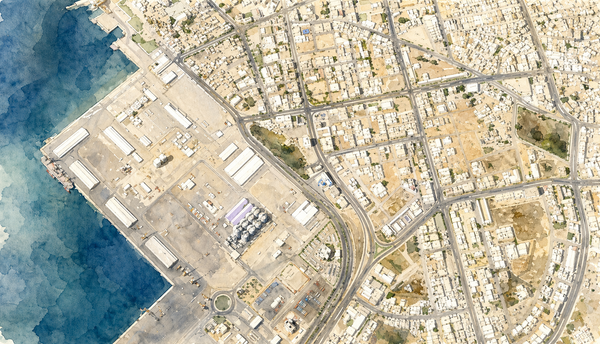
The City Without a Government: At Gurgaon, India Pioneers a New Take on the Ghost City

Once India's Hottest New City, Gurgaon's Lack of Public Infrastructure Shows the Pitfalls of Privately Developed Cities
For the better part of a decade, the dominant anxiety about city-building in the developing world was the ghost city. As China built entire cities that were never occupied, the phenomenon painted a spooky image in the minds of westerners: wide boulevards without traffic, gleaming apartment towers without lights, shopping malls without shoppers, something almost post- (or pre-?) apocalyptic. China built them by the dozens and the world marveled at the audacity and shook its head at the waste. The ghost city became shorthand for the hubris of top-down urban planning.
There is another failure mode that happens when people arrive too fast. When a city grows so fast, and so far beyond the capacity of anyone to govern it, that growth becomes a catastrophe. When the market delivers what it promised too well and the infrastructure doesn't keep up and there isn't no government, the result can still be a disaster.
That city is Gurgaon.


How Gurgaon Got Built Without a Government
Gurgaon sits about 30 kilometers southwest of New Delhi, just across the Haryana state line. Three decades ago it was essentially farmland: flat, dry, unremarkable land on the edge of the capital’s sprawl. Today it is a city of roughly three million people, home to the Indian headquarters of nearly every major multinational corporation operating in South Asia, a forest of glass towers and luxury residential complexes, and one of the highest concentrations of corporate wealth in the subcontinent.
In the 1980s and 1990s the Haryana state government made a series of regulatory decisions that created the conditions for an urban explosion. It relaxed land acquisition rules, scrapped the Non-Agricultural Use Clearance requirement that had made converting farmland to development a bureaucratic ordeal, and licensed private developers to build townships directly. Firms like DLF, Ansal Housing and Raheja moved in fast, onto land the government had neither the resources nor the inclination to develop itself. The land was cheap, the regulatory friction was low and Delhi’s corporate sector was growing fast enough to absorb whatever they could build.
But nobody ever really planned the new city.
There was no municipal government in Gurgaon until 2008. A city of millions was constructed without a city government. Private developers filled the vacuum out of necessity: private water supply, private sewage treatment, private electricity backup through diesel generators, private security forces, the country’s first privately funded fire station, even the first privately financed metro line in the world. The makeshift solutions were a testament to private ingenuity and perhaps startlingly unsustainable: generators powering entire buildings and trucks transporting sewage off-site. The gated residential enclave became the basic unit of urban life. Inside the gates, amenities were often excellent. Outside them, the story was entirely different.
The spatial logic that emerged from this arrangement was one of islands. Each development was a self-contained system, optimized for the people who lived or worked within it and indifferent to everything beyond its perimeter wall. Roads connected the islands to each other and to Delhi, but the connective tissue of a real city, shared stormwater infrastructure, coherent street networks, public space, sewage treatment at municipal scale, never materialized. It wasn’t that developers were malicious. It was that no individual developer had an incentive to build infrastructure whose benefits would accrue to competitors and strangers. The tragedy of the commons played out in slow motion over two decades, and by the time anyone had the authority to address it, the city had already been built in ways that made retrofitting prohibitively expensive.
Four Hours of Rain Revealed the Full Cost of That Arrangement
On September 1, 2025, it rained in Gurgaon for four hours.
Four hours of rain brought one of India’s wealthiest cities to a complete standstill. Traffic crawled for six hours. Expensive cars bobbed in floodwater on streets lined with luxury towers. Uber-premium apartment buildings were inundated. Residents waded through knee-deep water in neighborhoods where a square foot of real estate costs more than most Indians earn in a month. Golf Course Road, one of the most expensive stretches of commercial real estate in the country, lay submerged. A photograph circulated widely of a man hoisting his scooter onto his shoulders to navigate what was technically a public street.
None of this was surprising to anyone who lives there. The same scene plays out every monsoon season. It has for years. The flooding is a routine structural consequence of a city that was built without the drainage systems a city of three million requires. Without a central government, no single developer was ever responsible for building that centralized drainage system.
The flooding is the most visible symptom but not the only one. Economists Shruti Rajagopalan and Alexander Tabarrok, whose 2014 paper on Gurgaon remains the definitive academic treatment of the city’s governance experiment, documented the full scope of what private city-building without public coordination produced. Groundwater has been depleted at unsustainable rates because every developer and every gated community drilled their own boreholes, extracting from a shared aquifer with no mechanism to limit aggregate withdrawal. The Aravalli hills to the south, which historically recharged that aquifer and provided an ecological buffer, have been encroached upon by development pushing outward from the city core. Sewage treatment has been chronically inadequate because treating waste collectively would have required collective governance that didn’t exist, and individual disposal into common areas was always the cheaper option. The diesel generators that proliferate across the city, each one a rational individual response to unreliable public power supply, collectively produce air pollution that makes Gurgaon among the most hazardous places in India to breathe during winter months.
The market delivered the towers, but not the underlying infrastructure of a city.
Gurgaon Is an Inversion of the Typical Ghost City
A ghost city has too much supply (i.e. too much infrastructure and too many buildings) and not enough demand (i.e. people who live there). Gurgaon had more demand than any supply-side response could manage.
The standard ghost city critique holds that top-down planning disconnected from market reality produces waste at enormous scale. That is true and well documented. But Gurgaon’s failure is not a vindication of the market-knows-best counter-argument. It is evidence that markets left entirely to themselves at urban scale produce a different and in many ways harder-to-fix dysfunction, distributed and cumulative and largely invisible until a monsoon arrives.
Empty towers in many of China's most famous ghost cities eventually filled in when economic conditions changed. Poisoned aquifers, collapsed stormwater capacity, and public streets in need of retrofitting for basic infrastructure is much harder to fix, and the solutions can cost runs into hundreds of billions of rupees.
Gurgaon produced private excellence on individual properties and a degraded commons outside them that nobody owned or maintained. The city has, by some measures, the highest per-capita concentration of residential air purifiers of any city in the world. Its upper-middle-class residents have collectively spent staggering sums on technologies to compensate for the public goods that collective governance would have provided: air filtration, water purification, backup power, private security. They paid for the city twice, once through property prices and once through the private systems required to make living there tolerable.
And increasingly, they are simply leaving. The upper-middle-class exodus from Gurgaon to newer planned communities along the broader Delhi-NCR periphery, particularly toward Dwarka Expressway and the emerging districts further southwest, is well documented and accelerating. While there are still gleaming towers, the place lacks the shine it once had. It turns out, sometimes you do need planning and functional drainage.
Why Faridabad Never Had This Problem
The comparison that puts Gurgaon’s failure in sharpest relief is its neighbor Faridabad, an older, government-planned industrial satellite city on the southeastern edge of Delhi.
Faridabad grew under conventional state-led development frameworks: slower, more bureaucratically constrained, less glamorous and far less attractive to multinational corporations seeking South Asian headquarters. For most of the 1990s and 2000s it was held up as the cautionary tale of what heavy-handed state planning produced compared to Gurgaon’s dynamic private-sector energy.
Faridabad also has stormwater drainage. Its groundwater table, while under pressure, has not been destroyed. Its basic public infrastructure, while not excellent, functions at a level that does not collapse under four hours of rain. The government that planned it, however imperfectly, at least planned it.
The deregulators who pointed to Gurgaon’s corporate dynamism as vindication of their approach were not wrong that loosening land restrictions created economic activity. They were wrong that economic activity and urban functionality are the same thing. A city can generate enormous GDP while systematically destroying the environmental and infrastructural foundations on which its own future depends.
India Is Building Dozens of New Cities Right Now
This would be primarily a historical case study if India were not in the middle of the most ambitious urban construction program in its history.
India will add 200 million urban residents over the next decade, and is building greenfield cities across its landscape: Dholera in Gujarat, meant to be a semiconductor and industrial hub along the Delhi-Mumbai Industrial Corridor; Amaravati in Andhra Pradesh, a Foster and Partners-designed capital city on the Krishna River that has already been built, abandoned and revived once along political lines; a dozen additional smart city corridors at various stages of planning and construction. The central government has committed a trillion rupees to an Urban Challenge Fund in its 2025-26 budget specifically to accelerate this program.
The Gurgaon experiment, as spectacular as it was in generating economic activity, produced a template that cannot be replicated at this scale without consequences that would make the current dysfunction look mild. A Gurgaon-style governance vacuum applied to a city of five million produces problems of an entirely different order than one applied to a city of three million. The infrastructure deficits compound nonlinearly. This should be of particular resonance in Africa, where the massive anticipated growth of many of the continent's major cities is projected to occur well ahead of the ability for central governments across the continent to build city infrastructure to support that growth.
India’s Smart Cities Mission, which wound down in March 2025 after a decade of mixed results, represented a belated and imperfect attempt to ensure that state capacity accompanies private development in new urban projects. It failed in many of its specific ambitions but got the basic diagnosis right: the government has to be in the room when cities are built, establishing the rights of way, the shared infrastructure systems, the governance frameworks, before private development fills the land. Not after.
The ghost city failure in China came from too much state and not enough market signal. The Gurgaon failure came from too much market and not enough state. India, trying to thread that needle across dozens of projects simultaneously at a scale no country in history has quite attempted, is the most consequential urban experiment of the 21st century.
The monsoon comes every year. The water still doesn’t drain.
DISCLAIMER: The information presented across New Cities Atlas reflects approximate understandings of each city's development status, population figures, statistics, and trajectory, compiled from publicly available sources. It should not be taken as verified or definitive fact. New city developments are, by their nature, a moving target, and information is often scarce, frequently imprecise, and subject to rapid change as projects evolve, stall, accelerate, or are revised entirely. We are doing our best to build as comprehensive and accurate a picture as we can of a phenomenon that resists easy documentation, and we appreciate your understanding of the inherent limitations in that effort.
If you have up-to-date information about any of the cities featured here and would like to help us improve our coverage, we would genuinely welcome hearing from you. Reach us at newcitiesatlas@gmail.com.