Living Tight: Hyper-Density Has Unlocked Possibility, But Squeezed Residents in China’s Cities

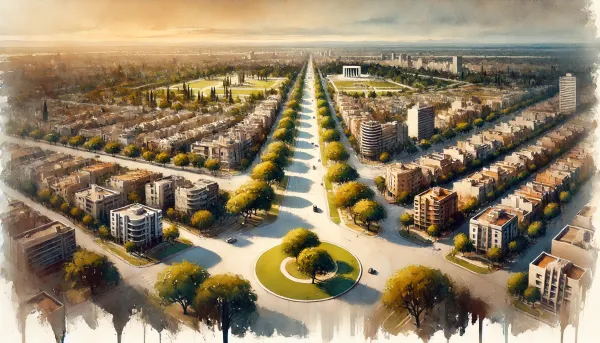
The first thing you notice is the sheer verticality everywhere. In China’s hyper-dense neighborhoods - pick a district, pick a city - Futian in Shenzhen, Finance Street in Beijing - the sky feels crowded, with high-rises stacked against one another in configurations that defy architectural logic sometimes, and repeat like a clonestamp at other times. It's still China. Washing lines stretch across narrow balconies, air conditioning units hum in unison, and the occasional rooftop garden emerges like an oasis amidst a concrete desert. But the forms are hyper-modern and hyper-dense. Welcome to the megacities of China, where hyper-density has been the rule, rather than the urban exception, for over 40 years.
In cities like Shenzhen, Hong Kong, and Shanghai, density has evolved from necessity to identity. Land scarcity, booming populations, and a government-led push for compact urban living have transformed these cities into laboratories of density. Yet, beyond the glittering skyscrapers and neatly planned superblocks lies a more nuanced reality, where innovation collides with ever-increasing real challenges around livability, affordability and social equity.
The Anatomy of Hyper-Density
Kowloon Walled City, Hong Kong’s infamous vertical slum, is a historical blueprint for density. Before its demolition in the 1990s, this maze of interconnected buildings housed over 33,000 people within just 6.4 acres. While its chaos epitomized the challenges of unregulated hyper-density, its layered spaces also hinted at the potential for close-knit, efficient urban living.
Today, modern hyper-dense developments reflect a more intentional approach. Shenzhen’s Futian District, for instance, offers a masterclass in vertical urbanism. Offices, apartments, shopping malls, and transit hubs are integrated into single developments, minimizing travel distances and maximizing land use. The scale is breathtaking: residential towers soar to 50 stories or more, and mixed-use complexes like Ping An Finance Centre create entire ecosystems within a single block. Yet, even these marvels of urban planning reveal cracks beneath their polished exteriors.
The Trade-Offs
Living in hyper-dense environments requires trade-offs. Residents often grapple with a wide range of issues, including livability, social stratification, environmental impacts, and perhaps unknown impacts on the human psyche.
Scale is one of the foremost issues. Apartments, particularly in older developments, are notoriously small. In Hong Kong, the median flat size is just 430 square feet, often shared by multi-generational families. In China, the average size of housing is about a fifth that in America, and nearly every young person grows up that way. It has created a generation of young people who recognize little in the international tradition of houses and families as their own, and not surprisingly, Chinese young people are not having kids. The true impact of these environments on the psyche of the young won't be understood for generations, since this is the first generation that has really grown up this way as a normal state of being. But the psychological toll of living in close quarters is invariably real. Studies have linked hyper-dense living to heightened stress, anxiety, and a diminished sense of privacy.
The contrast between China's impoverished past and its rapidly accelerating culture are ever-present in cities' vertical developments. Luxury developments and affordable housing coexist uneasily, with stark divides in quality and access to amenities. Gated communities for the wealthy - four or five towers around a shared courtyard - often contrast sharply with the overcrowded, aging housing stock available to the working class.
Further, while compact cities reduce sprawl and car dependency, they can exacerbate urban heat islands and strain infrastructure like water, electricity, and waste management systems.
The Innovations Driving Hyper-Density
Despite these challenges, China’s cities have become global leaders in rethinking what density can achieve. Several innovations illustrate how planners are navigating the complexities:
1. Vertical Greenery
In Shenzhen’s Qianhai district, the concept of “vertical forests” is taking root. High-rises are designed with lush, green facades, incorporating plants that improve air quality and reduce heat. This trend, inspired by Milan’s Bosco Verticale, is now a cornerstone of sustainable urban planning in China.
2. Transit-Oriented Development
Hyper-density relies on efficient transit to succeed. Shanghai’s metro system, with over 800 kilometers of track, is among the world’s largest. Developments are increasingly centered around transit hubs, with layered designs that connect residential units directly to shopping centers and train stations.
3. Smart Cities and Data
In cities like Hangzhou, hyper-dense districts are supported by smart city technologies. Sensors monitor traffic, energy usage, and even air quality, enabling real-time adjustments to urban systems. These technologies mitigate some of the strains associated with density by optimizing resource use.
4. Flexible Housing Models
To address affordability, cities are experimenting with modular housing that can adapt to changing family needs. Prefabricated units, like those used in Shanghai’s Lin-gang Special Area, can be expanded or contracted as households grow or shrink.
The Human Side of Density
One of the most striking aspects of China’s hyper-density is how it shapes daily life. In Guangzhou’s densely packed Liwan district, markets spill onto sidewalks, vendors shouting over the hum of mopeds. The close quarters foster community interactions, but they can also create friction. The elderly gather in shaded corners for chess games, while young professionals retreat to co-working spaces for some semblance of privacy. These layered social dynamics make density more than a spatial concept; it’s a lived experience.
A powerful example lies in the community gardens sprouting atop older apartment blocks. In places like Chengdu, residents have reclaimed underused rooftops, transforming them into shared green spaces. These initiatives not only improve environmental quality but also create a sense of ownership and connection among neighbors.
Lessons for the Future
China’s hyper-density offers lessons, both cautionary and inspirational, for cities worldwide:
- Equity as a Focus Has Reached China: While China has built merely to house the masses for a long time, it is rapidly confronting the reality that quality of place has qualitative aspects that affect different people differently. Density can’t just serve the wealthy. Integrating affordable housing and ensuring equal access to green spaces and amenities is crucial for creating balanced communities.
- Invest in Infrastructure: Density magnifies the strain on urban systems. Investments in efficient public transit, renewable energy, and resilient infrastructure are non-negotiable. Without the ability to move rapidly, density for its own sake is not pleasant.
- Foster Community: High-density living doesn’t have to feel isolating. Thoughtful design that encourages interaction, from rooftop gardens to communal courtyards, can turn crowded spaces into vibrant ones. There has always been a limit to how dense humans are willing to live, given other choice, but we are living in a time when we can live in a way that maximizes the levers of both density and livability in a way we haven't really been able to in the past. It takes a robust toolkit of parts to maximize the possibilities.
A Closing Reflection
China’s megacities are ever living experiments, testing the limits and possibilities of hyper-density. They remind us that density isn’t inherently good or bad; it’s a tool that reflects the priorities and values of the societies that wield it. From the glittering towers of Shenzhen to the chaotic energy of Liwan, hyper-density reveals both the brilliance and the challenges of human ingenuity. In these vertical cities, the future of urban living is taking shape, one crowded skyline at a time.